Showing posts with label TAGteacher Tale. Show all posts

Friday, June 27, 2014

TAGteacher Tale: Success After a Seminar

One of the great things about a TAGteach seminar - attendees go straight home, put the techniques into practice and see success right away.

Below is an example of how fast you can implement TAGteach in your lessons.
From Dagmar, an attendee form a seminar in Switzerland:

Dear Theresa: 
This morning, I had great success using the things I learned  at the TAGteach seminar in Sornetan.
It was the second lesson with the handler of two young dogs (16 and 18 weeks old). I knew her from a seminar I gave about calming stressed dogs. 
We worked on a holding the leash in a manner that may help calm her dogs.  Several behaviors including: taking hold of the leash, standing on one point, and relax as you hold the leash were put together and called "Standby". To simplify her focus, I attached a green piece of tape to her leash hand, and another piece of tape on her stomach. When she performed the "Standby" sequence, she just had to touch the two green pieces of tape together to have the perfect leash position. 
The instructions were: "Standby" and The tag point was "green to green". First, I demonstrated and tagged myself, then I let the client tag me, and finally they tagged themselves. 
First she felt a bit strange as she came from the hardcore dog training in German and Swiss dog places (Schutzdienst)...but then they realized how easily THEY learned the skills. I was so happy.
I repeated the mantra: “green to green”  and as the students became more relaxed with their behavior, the dogs also began to settle. 
Dear Theresa, dear Joey (Iverson), I thank you so much for opening up a world of giving training.
I hope I will see again soon
Dagmar (the musician )www.hundelongierschule.ch

Upcoming TAGteach Seminars 


Thursday, April 24, 2014

TAGteacher Tale: Helping Animal Shelter Volunteers Have a Great Experience

By Marissa Marino

Volunteers are one of my favorite parts about working for animal welfare non-profits. The community that is generated for a single mission can sometimes be astounding. There are a variety of reasons why people engage in volunteer activities. Some people volunteer to give back to their community, others volunteer since they cannot have pets of their own and others hope to develop friendships along the way. One common thread I see is people longing to learn new things and expand themselves.  So let’s give them what they want! My philosophy is to empower volunteers through education in order to develop a dedicated and helpful team for the staff as well as the animals.

For the last 3 years, I directed the behavior and training department at the East Bay SPCA in Oakland & Dublin, CA.  During that time I developed nine volunteer programs to help support our canine and feline populations. A  few of these programs focused on canine and feline enrichment, assisting dog training classes, canine jogging and exercise as well as canine behavior modification. 

Creating Educational Materials


In order to develop these programs I had to create educational materials as well as hands on training curriculum. There were many skills the volunteers needed to learn in order to safely interact with our animals.  Some of these skills included what to do when an animal mouths you, exiting and entering the kennel as well as offering an animal space and time if they appear fearful. I have found that breaking things down into small steps for volunteers can be most helpful when teaching a new skill. I used the principles of TAGteach in order to help each learner absorb the information and develop the necessary handling skills. 

Developing Your Own Trainings 


In my upcoming webinar, I will discuss handling skills all volunteers should know when working with animals. I will also showcase videos demonstrating volunteers learning these and other skills.  Since every shelter is different, it is important for you to take the knowledge you learn from this webinar and be able to apply it to your facility. Therefore, I will discuss how to develop TAGteach trainings for your own volunteers so you can all reap the benefits of this way of teaching.  

Webinar!


We hope you will join us on May 6th, 2014 for a fun and exciting webinar with Marissa!         

Click here for more information or to register.

BONUSES!


In celebration of its International Dog Bite Prevention Challenge, non-profit Doggone Safe will donate a Shelter Family Safety Kit in a random draw to one attendee at the end of this webinar. This kit contains materials to help educate the families that visit the shelter about how to treat pets with respect, read dog body language and prevent dog bites. The retail value of this kit is over $300 and it contains:

1 Be a Tree Teacher Kit (contains 15 large heavy weight dog body language posters and more)
50 Coloring Books
20 Story Books
2 Posters
500 stickers

Anyone with a shipping address in the US or Canada who registers for the webinar will be eligible for the draw. So even if you can't attend, register anyway! You will automatically receive the recording when it is available.

To find out more about the contents of the Shelter Family Safety Kit, visit the Doggone Safe store.


BONUS#2! When you register for this webinar you will receive a discount code for 25% off our recorded webinar: TAG! Not Just Another Game at Camp. If your shelter runs summer camps for kids, this webinar will give you lots of great ideas for fostering cooperation and fun for your campers

BONUS #3! When you register for this webinar you will receive a discount code for 25% off our recorded webinar: Leave it! Impulse Control for the Teacher with TAGteach cofounder Theresa McKeon, since this is a great complement to this webinar for training shelter volunteers.


Thursday, April 17, 2014

TAGteacher Tale: Junior Scholars Love TAGteach

By Sarah Cook

After many happy years as a teacher at A Dancer’s Dream, I recently branched out into the world of public education, accepting a position as a full time dance teacher in a charter School network in Boston, MA. For those unfamiliar with A Dancer’s Dream, it is a wonderful studio where every teacher is TAGteach certified and the children are very tag savvy. This particular charter school network is a high performing K-8 charter school with 3 campuses. The schools are academically rigorous, have a very strict behavior policy, and are huge on positive reinforcement and behavior narration.  They also have every student take dance. The dance classes are large, with 27-32 students per class.  Needless to say, I have my hands full.

After a year and a half of struggling with huge classes, no mirrors, and less than perfect dance ‘studio’ conditions, I asked my principal if I could start using TAGteach. She said yes and I breathed a huge sigh of relief. I could finally introduce TAGteach and the audible marker to all my classes.  Below are a few highlights from our first week using TAGteach.

Sixth grade:  We are well into our tap unit. With 27 kids in class, it’s challenging to see and correct the mistakes of every child.  How do you solve problems like too many kids, not enough time? With TAGteach, of course! After watching the entire class attempt flaps (a tap skill) and making a mental note of the most common errors, I chose one student to start the process.  I explained what a tag meant and how it helps your body and brain learn.  In less than two minutes and with only two tag points, his flaps were fixed. Not only did it fix his flaps, but everyone in the class vastly improved after watching the TAGteach session. They were thrilled and just a little amazed. I was just reminded of the effectiveness of TAGteach
.
First grade:  There are 32 children in this class (THIRTY-TWO CHILDREN!!) In an effort to streamline my classes, I decided to start using TAGteach to work on class management first. As the class began, I kept an eye out for the first scholar who quietly sat down in crisscross. Without saying a word, I tagged him and voila!  The room went from chaos to silence in 3 tags. It was so easy, They figured out right away that if they didn't get a tag, they could look at a friend who did get tagged and fix their behavior to match. My entire class was silent, ready to go without redirection from me and in less than a minute. One scholar told me “I like the tagger because when you tag one person, we all know what to do without you talking and wasting our learning time”.  Right on, kid - me too.

I am so excited to have brought this tool to my school. We accomplish more in less time, our practice is more deliberate, and everyone is happier. I know it makes helps me stay calm and focused. 


Now, someone remind me why I hadn't done this before…? Stayed tuned for more Adventures of Tagging in the classroom!  

Tuesday, December 17, 2013

TAGteacher Tale: I Cried Like a Baby for an Hour


By Kelly Drifmeyer

My name is Kelly Drifmeyer, I’m a classical musician on the Horn (French Horn), and a college professor at the Crane School of Music, SUNY-Potsdam. I’ve also trained and enjoyed the company of golden retrievers for 24 years.

I first woke up to the idea that I could learn and teach in a different way about 23 years ago. My early learning experiences as a hornist were with artist-musicians I think of as “old school” teachers. They learned how to teach from their teachers, and they from theirs, back to the European masters of the instrument back to who-knows-when. What they all had in common was a thick language of instruction on “how” to do things, and a negative and often punitive style of correction when you didn’t do those things right. There was one right way – their way – and to not follow instructions to the letter, or not provide the ideal result, was an invitation to a browbeating, embarrassment, or demeaning and sometimes harsh verbal correction. “You’ll never be successful sounding like that…that’s not good enough…you better find a different career,” these were all commonplace comments in both my own experience and the experiences of my fellow students. None of us liked it, but it became a badge of honor to survive lessons under those conditions and not break down.

When I started my own music teaching, it was about the time I also began formal dog training. In the early ‘90’s in my area this consisted of the “jerk and release” methods of instruction and correction. You said “good girl” in an anemic sort of way if they did it right, and yanked them around on the end of a leash when they didn’t. My first, sensitive golden began to avoid me on training nights, and at home she would startle and cower at the slightest raising of my voice – whether it was meant for her or not. We stopped training, how could I keep abusing my sweet girl like that? I finally went hunting at the bookstore for something different (this was pre-Google!) and stumbled upon “Don’t Shoot the Dog!” by Karen Pryor. I read it, and re-read it, and felt immediately guilty for being so stupid when there was such an obvious alternative. A “clicker” wasn’t easy to come by, but I found one eventually and off we went into dog training happiness.

It was quite a while later when I connected the dots to myself, and to my horn students. My early training (and being a perfectionist) had left me with a pile of mental self-abuse chatter that turned “on” every time I picked up the horn. I couldn’t practice, rehearse, or perform without a stream of negative thoughts flowing through my head. I almost quit the profession twice. I struggled with auditions, the one and only way to get a job in the performance field. I played beautifully at times, and had meltdowns at others. Nothing was ever “good enough”, so the angry commentary never stopped. Worst of all, I saw the same attitudes and negativity in my own students.

Tagteach isn’t where I started, but it is where I ended up. I tried the Artist’s Way, the Inner Game books, Peak Performance ideas, even “positive speaking” models, nothing solved the problem completely - until I picked up my dog clicker and used it on myself. I gave myself one task, used positive-only feedback, and ignored the bad stuff because it didn’t matter. The first time I tried it, I cried like a baby for an hour. And then went back and did it again.

I used this method for several years on my students and on myself before I discovered TAGteach in 2010. Another revelation – I wasn’t secretly doing something bad by using my dog training skills on my students, other people were doing it too! I read every inch of the website, watched every video I could find, took the online class and wanted more. In Spring 2011 I went to my first workshop with Theresa McKeon and it was amazing! I didn’t have the easiest time there – I had been using a self-taught method with a more relaxed structure, and I struggled with the new format and new terminology. But with practice has come an understanding of how the language of TAGteach helps me define my own thoughts, and helps my students with their own frame of reference.

I now use tagging regularly for specific tasks with all of my students. They universally respond in a very positive way, and many of them will ask for a tagging session when they find they’re struggling with a particular activity. I don’t use it every lesson, or for everything, but its an invaluable tool when working on high stress or high frustration problems. I find it to be especially effective when working on more physical issues. Musicians frequently work with muscles on a micro level – tiny, flexible motions of tiny, fragile muscle groups. Stress and tension can ruin the ability to use these muscles correctly, and I’ve found tagging lowers frustration, which lowers tension, which creates a calmer, more relaxed learner. And like magic, the relaxed learner is a successful doer.

The “magic” of TAGteach was brought home to me just a few weeks ago. I have a new student, “Amy”, who is bright, hard working and dedicated. She is also a mental and physical mess – tight, twisted posture, loads of tension, and a low threshold for frustration. She gets upset at the smallest things, and I sometimes walk on eggshells trying to get her to correct a problem without having a full-on meltdown. I’ll be honest – Amy was not my favorite student. I was irritated by her touchiness, and I’d lost patience with her meekness and sensitivity. It was no surprise that in a recent lesson, I found myself correcting, and correcting again a singular problem she could not seem to manage. I was getting frustrated, my voice was getting louder - when I noticed her hunching lower and lower in her chair, getting smaller and tighter at every attempt. Just like my sweet, sensitive golden almost 20 years ago.

Stop, I said to both of us. I took a deep breath and picked up my tagger. “This is a tagger. When you hear this sound - *click* - you’ll know you’ve done it right. If you don’t hear the sound, just try it again, no problem.” That’s all I told her the first time out. I took her through a focus funnel – explained what we were doing, then defined a single task, then gave her a single tag point – and off we went. And I felt stupid all over again for not having done it weeks earlier – she was finding success within ten minutes. And more importantly, she was then able to successfully integrate the new skill into a larger, more complex format. She also remembered, and repeated, the newly won skill for me the next week, and the next.

What’s most interesting to me about this story? I like Amy more now than I used to. We’ve found a way to communicate that takes some of the friction out of our relationship. She learns more confidently, and I’m also more relaxed, knowing I can say what I need to without hurting her.

TAGteach is an elegant, simple, precise language I use to interact with myself and with others. It’s a gateway to learning and teaching that bypasses the traditional use of negative feedback that so often produces frustration, stress, anger, and resentment. The teaching of musicians is shrouded in those traditions passed on through generations. That seems great to me in “what” we learn, but “how” we learn it needs some help. TAGteach resolves so many of the barriers to effective learning and retention, I’m spending a semester on sabbatical in 2014 to improve my own understanding of TAGteach and show others in my field how useful it can be.

Kelly Drifmeyer
Associate Professor of Horn
The Crane School of Music SUNY-Potsdam
Potsdam, NY 13676
drifmekb@potsdam.edu


Wednesday, December 4, 2013

TAGteacher Tale: A Winning Approach to Transforming Your Instructor


TAGteacher Joey Iverson has successfully introduced TAGteach to the tennis world, although she said it’s for selfish reasons. “I want to be the best tennis player I can be and that will happen faster if my coach uses TAGteach!”

"I explained a few of the tools to my coach Grant Grinnell (USPTA) and he was willing to give it a shot. After just a few tries, he was totally sold on the value of TAGteach and the powerful learning it facilitates. He commented that there was more improved play in my game within a single lesson. He also noticed that although it was easier to get information to me with the marker, it also required a different focus. In a group lesson he is usually trying to take in what each of the players is doing. To tag me for the skill, he had to momentarily keep his focus on just me or he would miss the marker timing. Both of us had complete focus and that brought about immediate improvement."

It seems Joey’s coach is as excited about TAGteach as she is:

“I love everything about what you've taught me. I love the tag, I love the positive reinforcement. I love no negative connotation. I love the focus of what I need to do and I love the focus of what students can do if they are tagging somebody else. I love everything about it, it's fantastic and I plan on using extensively in my teaching in the future.”

The word is spreading fast. After watching a TAGteach session between Grant and Joey, another coach, Chad Smith USPTA wanted in. It wasn’t long until he found exactly why TAGteach worked for him.

“TAGteach worked for me because I could mark the exact point I need my students to feel in my lessons. My students quickly associated the tag with what I was trying to get them to understand in their technique. It made my instructions that much more effective.”

Thank-you Joey for spreading the word effectively and kudos to Grant and Chad for being coaches that are open to new concepts that improve learning for their students!

USPTA Tennis Coach Grant Grinnell Talks About TAGteach


Join us for a webinar with TAGteacher Joey Iversen on May 20, 2014 where we will learn about strategies for helping to transform your instructors, teachers or coaches so that they can begin to teach the way YOU want to learn. Click here for more information or to register.

BONUS! Register for this webinar and you will get a discount code for 25% off our recorded webinar: Sport Coaches: 4 Thing Your Athletes Wish You Knew. This webinar covers specific details of TAGteach for Sport Coaches.

DOUBLE BONUS! Register for the Sport Coaches webinar recording and you will get a free pass for your coach or instructor.

Monday, September 23, 2013

TAGteacher Tale: TAGteach - How Learning to Tag has Changed My Life

By Katie Scott-Dyer

Reprinted with permission from: http://blog.verypets.co.uk/
546976_517045215052874_213040694_n
Who can spot me?

A bold statement but true nonetheless. I recently attended a 2 day TAGteach Primary Certification seminar in Bristol UK and it has revolutionised my thinking and strategies for coaching my own learners. Why? Because it cuts out all the blurry stuff, all the fluff and fuzz that can easily lose the learner in the fog of information.

This means that learners can have a clear goal or tag point, which is marked with an audible distinct sound such as the word tag or a clicker. This can be applied to any learner, be it human or animal. The instructions are finely sliced, the tag point is delivered in 5 words or less and gives immediate feedback of success to the learner at every tag point stage. It’s clear and simple learning with positive reinforcement, which can be tracked with a tagulator (beads on a string) that can be collected for a primary reinforcer or just the immediate success acts as a reinforcer for the learner. The science geeks among us know this as operant conditioning. OK so why the hooha about it changing my life?

I am on the Autism Spectrum. I’m both high and low functioning but have achieved a level of integration in ‘normal’ or neurotypical society because of my higher functioning attributes. It has been a difficult path to walk alone though. If TAGteach had been around when I was a kid I may have a had an even more successful, less frustrating, anxiety ridden childhood and been a higher achiever than I currently am. Plus I can still find it difficult to communicate clearly and effectively, even on relatively high functioning days. In class you can imagine the confusion which can arise from not delivering instructions efficiently to the learner. TAGteach will now be incorporated into my classes and has already been adapted into my coaching with measurable success. Having a tag point, clear determined goal which the learner can self select to personalise and even tag the teacher and each other is very empowering, makes the learning environment cooperative and progressive which can only be a good thing, right!

My gratitude to my TAGteach coach Theresa McKeon BA is infinte and I will always be indebted to the seminar organiser Sara Roberts KPA-CTP. Thank you ladies, my life will never be the same again! And being in the same room as some of the best animal and people trainers was inspiring too.

Learning never stops, I have a brain which mostly works but needs steering in the right direction at times so my aim is achieve Level 1 TAGteach certification. I had better crack on and get some TAGteach experience under my belt…

Here’s a link to the TAGteach International website, so you can see for yourself what I’m blathering on about: http://www.tagteach.com/


Thursday, September 19, 2013

TAGteacher Tale: Douglas Goes to Camp - The Magic of TAGteach in Action

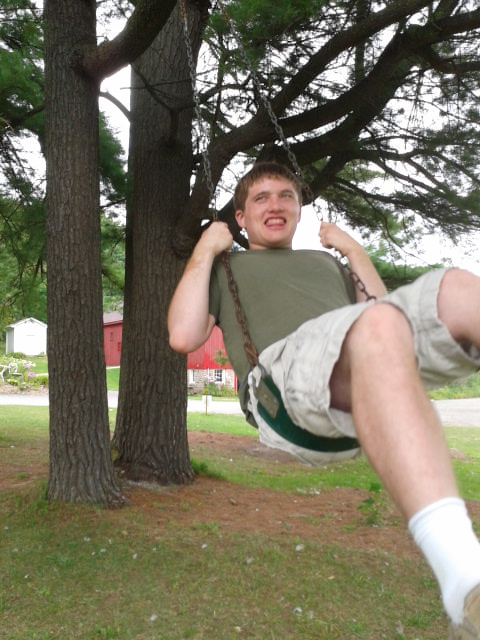
Smiling teenage boy on swingsteenage boy smiling, wearing blue life jacket 

By Joan Orr, MSc

Doug is the subject of the book Chaos to Calm: Discovering Solutions to the Everyday Problems of Living with Autism, by Martha Gabler. Martha explains step-by-step in the book how she methodically taught Doug many simple and then more and more complex behaviors necessary for life in a busy family. She used TAGteach, an approach based on the science of behavior, to teach new behaviors to replace screaming, running around, self injury and other chaotic behaviors with which many autism parents struggle on a continual basis. All Martha's teaching used positive reinforcement to strengthen desired behaviors. Now Doug is 17 and his self-stimulatory behaviors are almost non-existent. He chooses to exhibit behaviors that he has learned and that have become more reinforcing for him than the chaotic and sometimes violent behaviors in which he engaged during what Martha refers to as "the dreadful early years". Doug at 17 is happy, affectionate and cooperative. He loves his math and reading lessons and he loves outdoor activities. This summer Doug went to Shadow Lake Camp for a week and his counselor was my daughter Anne Wormald who is a level 2 TAGteacher. Martha came prepared with a tagger and some treats that Doug likes and left him in Anne's capable hands. Anne had read Chaos to Calm, so she knew many of Doug's tag points. The other staff at camp looked after Doug while Anne was on break and they too learned to use TAGteach with Doug. He had the whole camp trained by the end of the week! Here is what one of the other counselors said about Doug:
"He's so cute and well-behaved! When you first gave me the tagger I was kind of unsure, but once you told me about how he was before and I used it, it became obvious that it really works. I really want to read the book!"
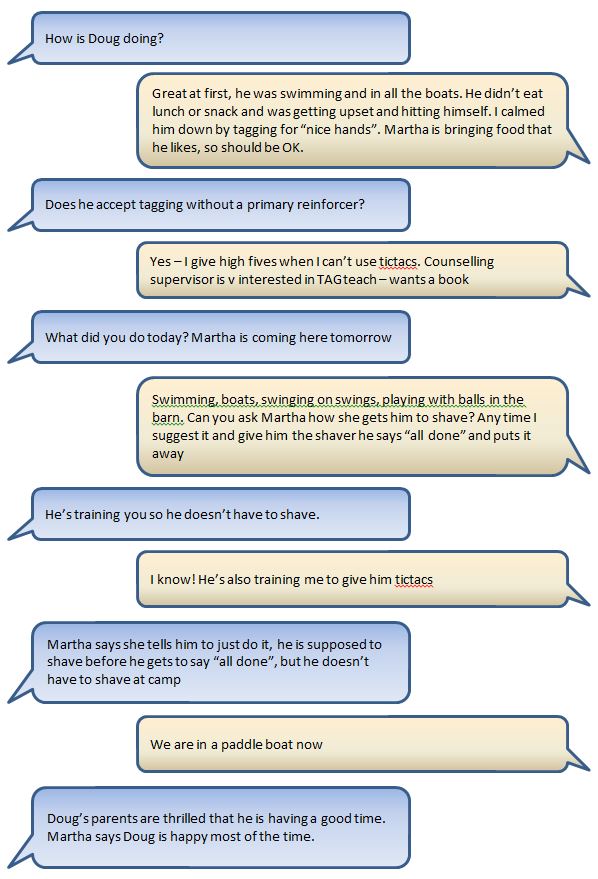
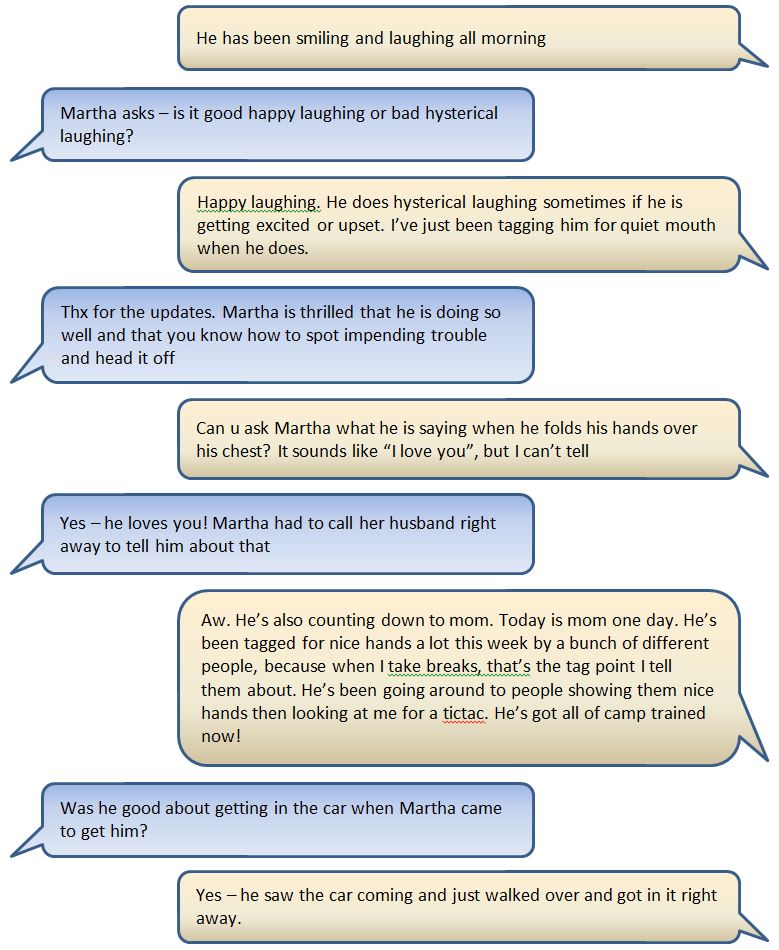
Doug's experience at camp is a testament to the power and effectiveness of TAGteach and the skill of Martha as a teacher. Martha was able to hand over her son, a tagger, some treats and some basic tag points and he was able to enjoy himself immensely at sleep away camp for a week with strangers. Anne kept in touch with me by text during the week with Doug. Here is a transcript of those messages:

camp texts 1
camp texts 2

Here are some videos of Doug having fun at Shadow Lake Camp. In the swing video, Anne is tagging him for "hands on". He had been letting go with both hands at the top of the upswing so she gave him a tag point for a behavior incompatible with the undesirable behavior. You can see from the video that Doug no longer needs to get a treat after every tag. He will in many circumstances defer the reinforcement in order to keep on doing a fun behavior. The swinging behavior itself is reinforcing to Doug and he would rather keep doing that, than stop to come and get a tictac after each tag. This is a good example of a learned behavior that has become self-reinforcing.


Click here to read more from Martha Gabler and how she taught Doug to be confident and cooperative enough to be able to enjoy himself at sleep away camp for a week with strangers.


Tuesday, September 17, 2013

TAGteacher Tale: Out With the Rules, In With the Tag Points!

By Gwen Hunter


I recently convinced staff at a new program for families with children who present with a gamut of behavioral challenges (ADHD, OD, autism spectrum, etc.) to try TAGteach. After a few telephone conversations they invited me to come and observe their most challenging class of 6 kids. Wow, it was chaotic and, frankly, dangerous. The following week I met with staff after school for a couple of hours, passed out info on TAGteach. They were excited. This class was the following day so I asked them to make a list of the behaviors they didn't like below each student's name. Then we went over each item, added an = sign next to each, and came up with behaviors they'd like instead (what a helpful tool this is! Thanks for teaching it.) These became tag points. I gave them taggers and we decided on tictacs for primary reinforcers. They then split up the kids so that each of us would have two to tag. I was really nervous about this as in the past I'd only tagged when working one-on-one with a student plus I didn't know these kids, but we decided to approach this as a learning experience - which it certainly was!

Only two kids showed up - two were on a camping trip and the other two, twins, were at an appointment with their mom. The boy who showed up had only one 'negative' behavior on his list: "he hates to move," so his tag point was "adventure try." The girl who attended had several behaviors on her list: "launches herself," "unsafe," "interrupts," "loud voice." We did not come up for tag points for unsafe and body launching, but "raise hand to talk" and "level 3 voice" were tag points.

The teacher did a beautiful job of describing TAGteach and tag points. The girl was tagged for raising her hand and darn, it didn't feel right to not tag the boy who was sitting listening, so he was tagged for 'eyes on teacher.' This was a good way to deal with a possible inequity, where the child who has behavior issues gets lots of tags, while the child sitting quietly gets none. After explaining and demonstrating tag, the teacher asked the kids what they wanted to do. The boy was tagged for suggesting setting up an obstacle course (the kid who hates to move!), and he and the girl brainstormed ideas. The girl got lots of tags for "level 3 voice" and together and under their direction, we set up a challenging 10-part course involving pillows, swings, hammocks, a squeeze cow that shoots balls, a target, and a slide. WOW! The boy demonstrated the route first, which involved lots of moving! Tag points for the girl that addressed safety became obvious during this activity: "feet first," "ask adult for help," "warn when starting," "wait until B has finished." At the end of the hour, the boy reached into his pocket, pulled out a large handful of tictacs, looked up and me and said, "Look at all the tags I got!"

There were no behavior problems during this class, and after the kids left the staff was incredibly excited about the effectiveness of TAGteach! I pointed out the 'rules' list on the wall and suggested they change it (it was called Rules and involved lots of 'NO…."). Staff immediately took it down and replaced it with a list called TAG POINTS!


Tuesday, July 30, 2013

TAGteacher Tale: TAGteach After Hip Surgey

By Luca Canver (Level 3 TAGteacher)

My father-in-law had a hip operation, with replacement of the femoral head, last May. This intervention, almost routine, includes a long rehabilitation phase: Using crutches, recovery of muscle tone and adopting good postures when walking. This is not easy, because in addition to the intervention, we must add the habit of poor posture (caused by pain to move the leg before the surgery). After the hospital days, and a first rehabilitation period, the person returns home with crutches to manage, correct posture to regain and therapy exercises to do.

Yikes, Information Overload! So I thought that TAGteach could be of help.

Tag Point #1: Toe on the Line

The first detail on which we focused keeping toes pointed straight forward. Seemingly an easy task, but to complicate the picture you must add the use of crutches. We started focusing on a single movement. Standing still we use, as target, the lines on the floor: We practiced the behavior "toes forward" isolating it from the rest of the movements and standing still. In the video, the tag point is: "Toe upon the line"


Tag Point # 2: Paired

In this kind of surgery patients are, obviously, required to use crutches. To optimize the loading of weights, crutches and arms are made to move in an unnatural way: moving at the same time the arm and leg on the same side of the body. For example: the right arm and right leg move in unison. An unnatural movement to focus on, while at the same time remembering the toe that needs to go straight all while adjusting to the use of crutches.

In the second video we have adopted a slightly different version of the cousin tag point: our attention was still focused on posture (toe forward), but we wanted to put it in the context of walking with crutches. For this reason the "toe forward" was included in the Directions. To help the person we used as a target a line on the asphalt (you can clearly see it in the video). The tag point has focused on moving parallel arm and leg. Aware of the difficulties of this I asked the person to label this behavior (a personalized tag point), so it was easier for him to process the information, freeing up a little bit of cognitive resources for toe forward. The answer was: “appaiati” ("paired" in English).

The directions are: "toe upon the line".

The tag point is "paired".


Editor's Note: You may have noticed two things about these videos: 
  1. The captions and the talking are in Italian, but it is easy for anyone of any language to understand what is going on. TAGteach translcends language barriers.
  2. The learner performed the task so easily that you might think, "What's the big deal?". In fact, TAGteach done well does look effortless and should. The skill of the teacher in breaking down the task, setting achievable tag points, starting from a point of success, creating a suitable environment and limiting the use of language to critical elements all work together to create the appearance of ease. Fantastico Luca!

Sunday, July 28, 2013

TAGteacher Tale: Stranger on the Train - A Tale of Compassion (Part 2)

Here is part 2 of Mara Windstar's tagging session with a stranger she met on the train - pretty racy stuff!

If you missed part 1 click here.


By Mara Windstar

This morning (Monday June 3, 2013) was the second TAGteach session with my new friend, for the process of learning ways in which he can get his needs met when traveling on the MAX train. This goal includes asking for a place to sit if there are no seats available.

Today's session was focused on him identifying how he might ask for a seat in a way that would be comfortable and natural for him. From my experience, this can be very difficult to come up with out of the blue for quite a few people. The TAGteach approach I took was different than I had done before.

Choosing the Tag Point

He decided what the tag point would be, and he would be the one to tag me verbalizing various requests for asking if I could have a seat.

He identified the tag point as: what I'm hearing is what I could say. (his interpretation was "that one!")

My goal was for him to be looking for how he wanted to express himself, as opposed to thinking "I would never say that!"

After 12 tags, he had a couple of key words that he could start with.

These included variations of...

Keywords that would work form him: anyone, offer, safety/prevent.

"is there anyone that could offer their seat for me please, to prevent a fall?"

"Thank you!!"

He was very excited about this. The key factor that he found working for him was "anyone". Asking a particular person felt very rejecting to him if it didn't work, and could easily trigger a response similar to the one that preceded our working on this. Also, eye contact can be very difficult, so he could pan a bit to look at people vs. eye contact with one specific person.

Practicing in a Real-Life Situation

Sequence 1

We met again this morning and boarded and exited the MAX numerous times. Our sequence went as follows:

1. Mara's chair parked in wheelchair location and Mara sitting on the aisle side seat in front of her chair.

2. Person asks if anyone could offer a seat, I responded confirming I could do that, and I moved into my chair.

3. Person thanked me for the offer.

4. We did this with the 2 configurations within the area for seniors and people with disabilities.


Sequences 2-4

Sequence 2, 3 and 4. with person boarding at different MAX train stops.

1. Mara seated in powerchair in designated area.

2. Person enters and asks "Could anyone please offer their seat for my needs?"

3. someone offered. and stood up

4. Person Thanked them for allowing him to prevent a fall!


Sequence 5

1. Mara seated in powerchair in designated area.

2. Person enters and goes to an area that is not in the accessible designated area and asks "Could anyone please offer their seat so I don't fall?)

3. someone offered. and stood up

4. Person Thanked them for allowing him to prevent a fall!

Going Solo

We made our way several miles and back. He feels he is ready to solo and is going to let me know how it goes. He also commented that he spoke to a person on the train on the last ride, which I also saw from a distance. He's never spoken to anyone on the train before, he's just been too uncomfortable!

These are exactly the kind of things that have been helpful for me to bridge outside of myself in conversations that I otherwise worried about.

Confidence really breaks down barriers... within ourselves.

Every day a new experience.


Friday, July 26, 2013

TAGteacher Tale: Stranger on the Train - A Tale of Compassion (Part 1)

This post is from Mara Windstar, who despite her own challenges, went to the effort of helping a complete stranger. You are awesome Mara!


Mara and Dixie the Service Dog
By Mara Windstar

Yesterday I was headed home after a great acupuncture treatment, and waiting for the transit train. It was the start of Friday night rush hour, so to say the train was crowded was an understatement. I entered the train in my power wheelchair followed by a young man who was walking. I've seen him numerous times, but never spoken with him as we have not sat close enough to one another to converse.

As I squeezed on with my monster chair he moved forward and asked a young woman if he could please sit down. The teen replied in a loud voice "you ain't no senior or disabled. And I ain't movin! I paid for this seat!"

I've observed in the past that the gentleman (early 20's in age possibly) has a difficult time standing and balancing on a moving train. He said nothing else, and was hanging onto a pole precariously. It was obvious that he really needed to sit down, but I knew he would not ask again nor ask any one else. This was a safety issue, and people were just staring at him.

I started to move my chair a little bit back and forth. A person on the opposite side of the aisle asked if I would like the wheelchair spot and I said yes and thanked him very much. I mentioned I was worried about safety and knew that spot was safer for everyone.

At the next stop, I asked the young man who had asked to sit down, if he could help me pull the seat down in front of me so more people could sit. He did so, and I invited him to sit down. He smiled, sat down and said thank you in a very quiet voice all without eye contact. I then transferred out of my powerchair and sat next to him. We started a conversation about a completely different topic from what had just occurred. The teen girl was fuming and cursing, "oh sure, you people all gotta stick together. That is so unfair! You don't even need that damn chair lady!"

"As a matter of fact I do, and it is not safe for me to transfer out of my chair on the train, any more than it is for my friend to stand while the train is moving. Since no one else offered a seat, I did. It's about safety. And I want you to know that if it wasn't safe for you, I would have found a seat for you also!"

I immediately went back to the conversation with the young man next to me, because I could sense we had some similarities in that he probably would just get off to avoid the discomfort of the situation.

We get off at the same stop, so I asked if he had a few more minutes to talk. Needless to say the conversation was far longer than a few minutes.

We talked about how hard it is to get our needs met when we have low self esteem, are ashamed of ourselves, or otherwise feel unworthy. We had more in common than he knew, that's for sure.

Before I knew it, we were mapping out what he'd like to be able to do in this type of situation, and how that might be possible.

We built an ongoing TAG plan for figuring how riding the train, and getting his needs met for safety could happen.

His goal is to secure a safe place to sit on public transportation, free from feelings of guilt.

To build confidence first, we are back chaining from the appreciation of having successfully secured a seat.

Our first session is completed.

The tag point was... "Thank you!"

Tomorrow is our next session and we are setting out to complete 2 more steps in the plan.

Stay tuned for part 2!

Wednesday, January 9, 2013

TAGteacher Tale: TAGteach + Clicker Training = Saving Endangered Species

Reprinted with permission from the KPCT Blog


Editor's note
If you have experienced the power of clicker training, you know it has the potential to save animal lives. One Karen Pryor Academy (KPA) Certified Training Partner (CTP), Jade Fountain, has demonstrated that clicker training can help save an entire species! Jade recently journeyed to South Africa, utilizing skills and knowledge gained through the KPA Dog Trainer Program to help safeguard the world's fastest land animal—the cheetah.
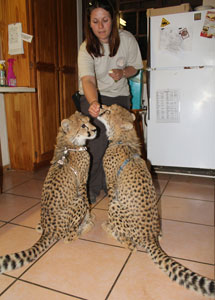
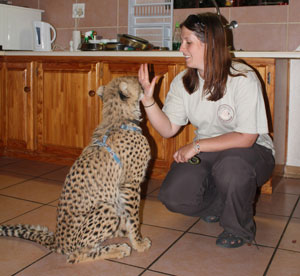
Jade Fountain with cheetahs
The cheetah is among the many species at risk ofextinction. Threatened by human persecution, habitat loss, poaching, and competition, the number of cheetahs has decreased drastically, with only 7,500 left in the world. One of the largest threats to cheetahs is conflict with farmers who see cheetahs as pests and trap, poison, or shoot them. Action to safeguard the species must be taken or cheetahs will become the latest casualty in the mass extinction of species.
As part of this effort, Jade helped train cheetah cubs to be comfortable with people. With this accomplished, the cheetahs can travel to schools, farms, and communities where they can inspire change by offering people the rare opportunity to interact with them. Here, Jade tells us about her work with these magnificent animals.

What led to your interest in protecting cheetahs?

I'm passionate about conservation. I have worked with endangered species programs in Australia for the past four years as a zookeeper, including the Save the Tasmanian Devil Program and the Brush-tail Rock Wallaby Recovery Program. As a professional trainer, I have a very keen interest in using behavioural management to improve welfare and reduce stress in captive breeding programs. The opportunity to travel to South Africa and work with cheetahs (and hand-raise orphan rhino calves, handle vultures, and be involved in rehabilitation) was hugely rewarding.

Tell us about how you became involved. Why did they select you?

I applied for the position when it came up in a zookeeping job list, and I was selected based on my qualifications and background in zookeeping, behaviour, and training. Being prepared to give up normal sleeping habits to bottle-feed the young cheetah cubs and work long hours, and my experience hand-raising kangaroo and possum joeys were all pluses.

How had these cheetahs been trained traditionally?

The two facilities I worked at had different training methods. Progression toward errorless learning and effective behaviour change is occurring slowly and is moving toward realizations like there is no need to flick a cub in the nose—it doesn't provide information to the learner and can increase aggression.
It was essential to me to introduce the science of how animals learn, teach how important it is to reinforce desired behaviour and ignore/redirect undesirable behaviour, and spread the influence of force-free training. A highlight of my trip was seeing both the cubs' reaction to clicker training and the complete change in their behaviour with positive reinforcement.
clicking cheetahs

What was the purpose of training the cheetah cubs? Can you describe your training program?

The cheetah cubs are ambassador animals, which means they need to feel comfortable and safe meeting new people, encountering novel situations, and travelling to different places to educate people. Asking people to interact, touch, and see for themselves what a cheetah is really like inspires change in attitudes toward persecution and poaching of these athletic cats.
We trained the cheetahs to sit, hop on to scales, station on platforms, wear harnesses, walk on collar and lead, use crates, and feel comfortable with veterinary examinations. I worked to implement positive reinforcement through use of clicker training. We used elements of the cheetahs' daily diet (a variety of different meats: springbok, elephant, kudu, or warthog) as rewards. The cubs learned very quickly, purred during the sessions, and changed their "teenage" attitudes toward the handlers.

What were some of the challenges you encountered?

The biggest challenge in training was probably getting all of the staff on the same page. Figuring out how to run a training session with three of the cubs in the room at the same time was also interesting and tested my training skills, timing, and rates of reinforcement. I think TAGteach helped me overcome these challenges and others I encountered.

What were the results of your training?

cheetah training
Prior to the training, some of the cubs had been giving the handlers trouble with stalking and pouncing, and with aggression. These behaviours included tantrums when the harnesses came out, a lot of hissing, and mouthing. We began clicker training during mealtimes, starting with putting "sit" on cue and getting the cheetahs to target our hands.
Within three ten-minute sessions, we saw a big change in the cubs' behaviour. As we progressed, the aggression and stalking dropped off, the cheetahs became more interactive with handlers, and the animals were easier to handle—they even lay still for vet examinations. The purrs coming from the cheetahs were extremely rewarding. Clicker training was successful in reducing their reactivity and aggression toward keepers. The cheetahs have been very responsive and easy to handle, walk, and interact with ever since.

Tell us about the impact on the staff. Will they be making any changes as a result of the success you had?

The last day that I worked with the cubs at the facility there were a lot of huge moments and some tears for the successes. It was certainly a big moment when the cubs looked up at their handlers and purred on approach—relaxed and willing to come over. This means that these cubs will be able to graduate from the ambassador program and help the conservation effort for their species.
Staff members have taken on clicker training, figured out the daily rations from the cubs' diets that can be allocated to training, and written a plan to get the cubs to be the most successful ambassadors that they possibly can be. Positive reinforcement and clicker training have already made a big difference in the program.

Do you think being a graduate of the KPA Dog Trainer Program helped you train the cheetah cubs successfully? How so?

I think that being a KPA graduate has given me necessary skills that apply to whatever species I work with. One of the skills that helps me most in teaching others is the TAGteach training that I learned during the KPA Dog Trainer Program. KPA helped me improve many mechanical skills and I am proud to demonstrate them for such important purposes.

Tuesday, July 3, 2012

TAGteacher Tale - A New Approach to Changing Behavior

by Leslie Catterall KPA-CTP


Reposted from http://chroniclesofaclickertrainer.blogspot.ca/ with permission


Since the early 80’s my work has involved working with people – teaching them, tutoring them, training them. Most of that work has been with children with a large chunk in the middle involving adults in the business environment. A theme that ran through nearly all my work was changing behavior – helping children with special needs fit into a classroom environment, working with people new to English acquire another language and engage with a different culture, assisting employees of a large retail organization to improve their performance, helping a large corporate organization get back on track with failing projects…the list goes on.

After 30 years of working with humans I made the switch to working with dogs. My primary reason for doing this was the new addition to our family – a traumatized miniature poodle named Blue. It was during my study with the Karen Pryor Academy last year that I first learned about TAGteach and since that first introduction I have been curious as to just how well it would work with humans in all the circumstances in which I have worked.

In May of this year, I certified as a Primary Level TAGteacher after completing online the comprehensive TAGteach IntroductoryCourse and keeping a journal throughout of my progress – both with the course itself and with TAGteaching. At the time I only had a few students and it seemed the right time to immerse myself in this new philosophy of learning and to really come to terms with all of its uses.

In any sort of training environment there are always doubters – whether it be the teachers of the students I tutored or their parents, a disgruntled manager considering that the training was a waste of time, or the students themselves believing that they’ve never been able to do this before so what makes this approach any different. In the past I have been used to dealing with this sort of response but it was not until I came in contact with dog trainers and owners that I experienced for myself how easily it is to question what you know to be true and revert to the “way everyone else does it”.

I found my students were so conditioned at focusing on what their dog did wrong and trying to correct that, that it was difficult to convince them that their dog’s behavior would change if they just focused on what it was they wanted the dog to do. I needed a new set of tools to deal with these situations so that I could demonstrate what I meant through the way I responded to my student. My normal approach of positive praise was not powerful enough – it lacked timing, accuracy and specificity – what exactly was it that they had done well? I found it increasingly difficult to answer this question when I came to write up my session notes. It occurred to me that I needed to change my approach and TAGteach seemed the most obvious choice to do that.

The TAG of TAGteach stands for Teaching with Acoustical Guidance and this approach is all about enhancing performance on any level in any situation by identifying what it is you want the subject to do, specifying it articulately and tagging (with an audible marker) every occurrence while ignoring everything else. It is clicker training for humans… and it works!

I tag everything now – my dogs, my husband, my clients and myself. I’m even starting to think in tag points and that has probably been the most beneficial aspect of this learning for me. What is it I want to achieve? Ah, yes…and the tag point is…

TAGteach has reaffirmed for me that there is always a way to get the behavior you want, you just need to be creative in your approach and engage the participants as much as possible. This is not just conditioning or behavior modification, though those are very much behind the science of this technique, rather it is more about clearly defining what it is that you are after in a behavior and expressing why.

The course required the completion of exercises at every stage and many of them required me to take a look at myself – at home, at work and at play. I was asked to look at things I wanted to change and to see them from a different perspective – how I want them to be. I learned to shift my focus from what was bugging me, to the much more positive – what would I like to see?

TAGteach in Action

Martin - my TAG partner
One of the many success stories I’ve had since completing the course was in the enhancing of domestic bliss. One of the issues I have in my home is that my kitchen is not large enough to accommodate me and my mode of cooking let alone play host to all the empties we seem to accumulate during the week. Ever since we’ve lived here I’ve nagged my husband to “Please put the empties in the recycle”, every morning there they are, neatly stacked on the corner of the bench and it is left to a rather disgruntled me to move them into the recycle box in the hallway.

One of the TAGteach mottos is “tag, don’t nag” and it is so true. Rather than continue to nag Martin about the bottle dump, I decided instead to engage him in the process. I explained my situation and my understanding of his. He told me that there was no malicious intent in his forgetting to recycle; he’d simply got into the habit of leaving the bottles there, a behavior that was hard to change when he was tired and focused on other things.

What an eye-opener that was to me. And since then I am seeing more and more how much of the behavior with which we are dissatisfied stems from patterns of repetition that are hard to break simply through being told. I invited him to engage in an experiment with me.

I’d learned all about the focus funnel in my course and while I could see how it would work in a teaching or coaching environment, I was curious as to how it would work in changing patterns of behavior between mutually agreeable participants.  The focus funnel literally draws together all the bits of information you want to get across and pulls them into a tightly constructed TAG point. I wanted to try this with our situation and Martin, the champ that he is, was willing to go along with it.

It became clear as we discussed options that there were several behaviors in need of modification: glass bottles, jars, and cans needed to be rinsed, plastic bottles needed to be crushed and recapped, and all needed to be put into the recycle.

TAGteach is all about focusing on one behavior at a time and as the ultimate behavior was to have a clear benchtop, I decided to back-chain the behaviors. Get the items into the recycle bin first, then work on the rinsing and the crushing at a later date. We came up with three tag points, one for each behavior.
Using the protocol for forming a tag point, we articulated them thus:
  • The tag point is… empties in recycle.
  • The tag point is… rinse non-plastics.
  • The tag point is… crush’n’cap plastics.

My job was now simple, all I needed to do was state (or create a sign) that articulated the tag point for that day, tag whenever I was present and leave it to Martin to do the rest.

Promoting behavior change is all about reward and reinforcement, whether it be intrinsic – the satisfaction of achievement, or extrinsic – getting paid for a job well done.  TAGteach International know this well and have devised an ingenious means of tracking tags received and trading them in for something more tangible – the tagulator. I have dozens of them that I made for my clients (they earn them with tags) and I gave several of these to Martin.

Simply put, the role of a tagulator is to record a tag whenever it occurs – Martin’s hang in the hallway, opposite the recycle bin and a tagger (clicker) on the shelf. Bottle goes in bin “tag”, slide a bead on tagulator.  The process has been going since our meeting on June 2nd, and in that time Martin has accumulated 67 tags. The top tagulator records every tag, and the second tracks the number of times he fills up the first tagulator – when the bottom tagulator is full, it’ll be time to cash in on any one of a number of “treats”.

Besides reflecting on the number of empties we go through in a month, it’s a very visual way of recognizing the effort that has gone into changing the behavior. I haven’t been involved much in the process since we set it up, other than to notice in passing the number of tags being accumulated. When I asked Martin why he still continues to do it he said, "it’s about presence of mind, committing to the whole process breaks the habitual behavior”. When pressed further he put it this way: “even though I’m the only one recognizing it, it gives me a nice feeling that I am being recognized for doing it.”

Is he convinced that TAGteach works? Absolutely, to the degree that we are now devising ways for Martin to incorporate TAGteach at his work.  

Am I pleased with the result? Totally - the evidence accumulates daily on the tagulator, but more importantly, I have a clear bench and there is no more nagging – now that’s a definition for domestic bliss. TAG!