Showing posts with label peer tagging. Show all posts

Thursday, October 4, 2012

Tagging with Teens at 4H Camp

by Kristen VanNess

Reprinted with permission from the KPCT blog
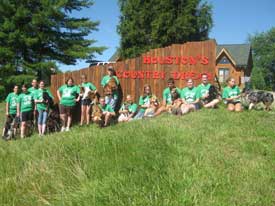

I'm part of a group that runs a 4-H dog camp each summer called The Ohio 4-H Teen Dog Experience. A group of teens from all parts of Ohio spends several days with their dogs and new friends in an intense dog-training environment. Eleven 4-H'ers and their dogs attended the four-day camp in June, 2009.

Kids come from different areas of the state, and have varied experience levels coming into camp. Some campers are from 4-H clubs that do not even offer obedience or agility, and other campers compete extensively outside of 4-H. Most campers belong to clubs that do not use clicker training. However, all of the campers were enthusiastic about dogs, 4-H, and learning how to be a better dog trainer.

Tagging at camp


For several years, we have worked on ways to reinforce the teens attending the dog experience camp. After attending TAGteach seminars and working hard to strengthen our plans for camp learning, things went even better than we expected this summer.
In past years, raffle tickets were passed out for participation, helping others, and demonstrating good training skills. It was difficult to carry the tickets around, not to mention distributing them without interrupting a lesson. More than once, a piece of hotdog was offered to the kids and tickets were given to dogs! This year, every camper made a ten-bead Tagulator TM (an ingenious and very cool way to keep track of the many tags earned) to use throughout camp. Moving ten beads on the tagulator to the "I did it" end of the tool earned a camper a raffle ticket. The kids would probably have found tagging reinforcing enough without a raffle, but our end-of-camp raffle has become a tradition.
Throughout camp, clicks or a "thumbs up" were used to tag the kids. During lessons with dogs present, we were more likely to use a "thumbs up" or a verbal tag, but during our many non-dog activities, a tagger could be used. Kids were encouraged to tag each other, and often did.
We noticed that while kids sometimes forgot to bring a piece of equipment to lessons, they very rarely were without the tagulators!

Creative problem-solving
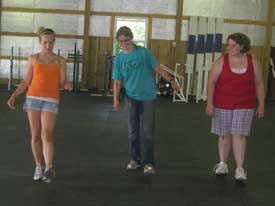
Early in camp, we did several sessions on creative problem-solving where the kids had to work together to solve tasks using a limited set of materials. We talked about how problem-solving could help with writing a training plan and solving training challenges. The lesson was not that the kids were able to accomplish the task at hand, but that they learned to brainstorm completely different solutions for any one challenge.
Throughout camp, we would TAG kids for use of creative problem-solving—resulting in more improvement than we anticipated. Some solutions they came up with were fabulous: move the target closer, walk the sequence without your dog, use our invisible dogs, tape the target to the floor. Of course, the kids moved on to brainstorming creative ways to get revenge on each other—and each other's cabins!

Vocabulary

One thing we made a point to TAG was the use of technical training vocabulary. Initially, we would TAG when any "training words" (timing, fluency, cue, front cross) were used. As camp went on, vocabulary tags were earned more for using training words in context. It was difficult to control my enthusiasm when the kids would offer suggestions:
"Maybe we should break it down."
"The latency is poor."
"The cues are similar—how does my dog tell them apart?"
"Let's use back-chaining!"

Place settings
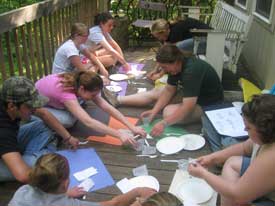
Cooking projects are a traditional part of 4-H. However, our campers come primarily from dog clubs and many have not experienced cooking-project judging and the associated lesson "learning how to do place settings." The place setting project is a great activity for teaching the campers about back-chaining, and is also an opportunity to learn a new skill.
Our brilliant Teen Counselors led the activity and directed the campers through the process of creating a place setting for a meal. The directions from the Teen Counselors specified the items to remove, the order in which to remove the items, and the requirements for different meals. Campers practiced setting and clearing the tables, placing cleared items in their laps to be ready for the next round. When cued to "return items," the campers would return the items in the correct order. A sample set of directions read as follows:
  • Remove cup
  • Remove plate (and above item)
  • Remove fork (and above items)
  • Remove spoon (and above items)
  • Remove knife (and above items)
  • Remove napkin (and above items)
  • Remove place mat (and above items)
After ten minutes of training, the campers were able to set up three different place settings on different cues (breakfast, dinner, and dessert)—all with accuracy.

Throwing dumbbells

With a little rivalry between the two cabins of campers, there were many opportunities for competition. A dumbbell-throwing contest quickly found its way into our curriculum.
Both teams grabbed some dumbbells and spread out for fifteen minutes of strategy and practice. After a few throws, we noticed that one of our campers was very accurate. We watched him make several throws, and then created some TAG points based on his technique. With suggestions like "Let go at shoulder height" for when to release the dumbbell and "Straight arm when releasing," the group was throwing more consistently immediately. Performance did deteriorate under pressure; we'll add some activities next year to improve responses when stressed.

Teamwork
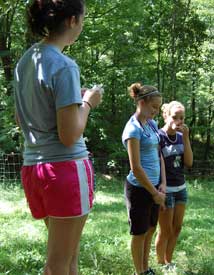
Photo courtesy of Megan Nelson
Teenagers sometimes have the reputation of not being helpful. But, a few tags for various household tasks had the kids on top of everything. The doors stayed closed. The trash was emptied regularly. The kitchen area stayed clean. Buckle collars were on all dogs.
Soon the campers were going out of their way to assist each other with tasks. This might have been expected when the kids were comfortable with what they were doing, but it was completely unexpected with new tasks such as tracking. All eleven campers were learning tracking for the first time. After the first day, they would offer to help each other set tracks, which really surprised the instructor. The campers worked to get each other to participate in all activities, and continued to problem-solve on their own.

See you next year!

TAGteach and good lesson plans had a huge positive impact on camp this year, and on the progress each camper made within only a few days. The kids were happy to TAG each other and the instructors.
The focus moved quickly from what was going wrong to what went well. Campers weren't only thinking about reinforcing their peers, but also about reinforcing the instructors. I was very proud when I overheard several campers talking about telling one of the instructors that her dog had made huge improvements since the previous year.


Wednesday, October 27, 2010

TAGteach and Sports - How to Eliminate Nagging

By Theresa McKeon

“This is the hundredth time I’ve told you…and last time I am going to say it…”

Ah nagging; the most beloved teaching tool in the world. Just keep at ‘em until they fix it, do it, drop it or stop it. In fact, experienced coaches, teachers and parents often use a highly advanced system called, multi-nagging. Hit them with multiple corrections every turn. One of them may stick. This leads us to the question…
How do you amplify the critical feedback athlete’s need, while reducing the amount of language that accompanies it? There is a way.
In a process called TAGteach, (Teaching with Acoustical Guidance) feedback from the coach is transmitted audibly with a simple device that produces a sharp click sound. This sound, called a ‘tag’, marks a single response, action or position called a tag point, and says, “Yes, that’s correct”. No tag means, “Self-assess and try again”. The feedback is positive and students don’t have to interpret verbal instructions or corrections while trying to interpret their own intrinsic feedback.

For example, a gymnast must learn the basic skill of keeping good form while performing a handstand. Instead of repetitive requests that bear a considerable resemblance to nagging, such as “get your feet together”, the coach can establish a ‘tag point’. A tag point is something the coach wants, phrased in a way that can be answered yes or no, such as “the tag point is…feet together”. If the athlete puts her feet together in the handstand, the coach marks the exact moment her feet come together with a ‘tag’. If she hears the tag, she hears success. If the athlete doesn’t hear a tag, she must self assess. No tag? She thinks, “The tag point was… feet together. Mine must still be apart.” The athlete decides on a corrective action, pulls her feet together and receives the tag. Changes are considered and made by the athlete through self-assessment before further feedback from the coach is given. Now the athlete is in charge of her progress with minimal intervention from the coach. This fosters accountability and reduces the need for immediate and constant verbal corrections.

Break it Down

The coach can also decrease nagging and boost the athlete’s chance for success by increasing criteria in manageable increments and limiting unsuccessful attempts. The athlete can only truly focus on improving one aspect of a skill at a time, particularly if it is a new skill. When they receive multiple corrections it’s a coin toss. Legs straight? Back straight? Legs together? Toes Pointed? Which correction is the most important to the coach? Even if they do make a correction, there seems to be a “better, but” that lands them in the “you aren’t concentrating” hole again. With TAGteach, the coach chooses and tags for the point that is sequentially most important to the make-up of the skill. If the athlete does not receive a tag within three tries, it is the coach’s responsibility to create a tag point that is within the skill level of the athlete. In all cases, tag points are addressed one at a time and the student does not receive commentary on other errors. These errors will be addressed in future tag points. Because the criterion for success is the attainment of the single tag point and not the completed, perfected skill, the athlete and coach can learn to appreciate incremental successes on that never ending road to perfection.

The Tag Point Is…

There are several direct benefits of using the phrase “The tag point is…” First, a tag point is always phrased in the positive. This helps both the coach and the athlete to focus on what should happen. “Your toes aren’t pointed”, becomes, “The tag point is…pointed toes.” “Stop bumping the volleyball with straight legs, there’s no power in that” becomes “The tag point is…bent knees”. Now both parties are focused on what should happen instead of what shouldn’t happen.

Secondly, the unique construction of the phrase sets the stage for a balanced relationship between coach and athlete. Jim Mernin works with athletes of all ages and cognitive abilities in the art of horsemanship for the Festina Lente equestrian facility in Wicklow, Ireland. He found his students felt less intimidated when objectives were phrased “The tag point is…” instead of the standard “I want you to ….” The absence of the words “I want” allows the coach to become more of a facilitator and less of a dictator. This leveling of the playing field is not lost on the learner. Jim says the phraseology helps create a relationship with his students based on assistance instead of dominance, opening the door for better communication and respect.

Finally, because tag points are broken down into easily recognizable bits with simple yes or no answers, athletes can become the ‘coach’ and tag each other. We call this ‘peer tagging’. Athletes instantly fill with a sense of responsibility and pride as they are handed a tagger and put in charge of deciding if the tag point was preformed or not. They learn to look for correct actions in their partner, while mentally reinforcing the same points within themselves. The student who teaches learns twice.

For instance, a baseball coach breaks his team members into groups of two. The tag point is… step into the swing. One player is the ‘coach’ and will tag if the tag point is achieved. The second in the pair is the ‘athlete’ and will perform the skill. Each group of 2 is now completely focused on their individual assignment and after a set number of tags can flip flop the coach-athlete role. Each athlete is now getting a mental workout even though they may not be the one currently performing the skill. Bonus- with the athletes tagging each other, the coach is now free to give an individual attention, without halting the rest of the group.

Positive Reinforcement

Historically coaches are not given many tools to focus on the good. We acknowledge something performed correctly only as long as it takes to consider what still needs to be improved. The key to TAGteach is to increase a correct response, action, or position by pinpointing and reinforcing it. Although studies show that especially in adults, feedback and accomplishment are in themselves reinforcing, the definable and measurable successes of the audible tag can be counted and used in a token economy. As an athlete collects a pre-defined number of “tags,” she may choose to turn them in to “buy” stickers, trinkets, come in late on a Saturday practice, choose the next skill, or even choose next tag point. Groups of athletes can combine their earned tags and turn them in for open gym time, compete in skill contests, or team sleepovers.

Working with Special Needs Athletes

Although TAGteach is being utilized by nationally ranked main-stream athletes, the methodology of marking a predefined response, action, or position (the tag point), utilizing non-threatening language and positive reinforcement also make it perfect for work with the special needs community as noted by the following: Special Olympics: “We saw an almost immediate improvement in skill execution and confidence in our Special Olympics rhythmic gymnasts”, said Debbie Boycott, head coach of the Oakville Butterflies from Oakville, ON Canada. “The athletes were very quick to understand and appreciate this way of teaching and were even able to teach each other using the TAGteach methods”.  [Editor's note: Athlete Emily Boycott won 5 gold medals in Special Olympics rhythmic gymnastics]

Jennifer Golynsky, Special Olympics coach in aquatics and tennis relates, “I have been coaching Special Olympics for 11 years and feel that TAGteach is aligned with the Special Olympics philosophy in that it emphasizes positive reinforcement, athlete confidence and breaking down skills into manageable tasks.

Students with Autism: “Applied Behavior Consultants, Inc., founded in 1986, by Dr. Joseph Morrow and Brenda Terzich, M.A., has provided behavioral services for over 3000 clients worldwide. TAGteach™ allows us to be “language-free” with our reinforcement. This is a tremendous benefit since many of our students have communicative deficits. Once paired with a reinforcer, the “tag” is universal. Preliminary research at ABC, Inc. has shown positive results using TAGteach and positive behavior change. TAGteach™ is not just for competitive athletes and gymnasts; it can be proven functional and invaluable for children with Autism, as shown here at ABC, Inc.”  [Editor's note: visit our website and blog posts for research on TAGteach and autism]

Say Goodbye to Nagging

Like the much loved video game, TAGteach provides instant, positive, audible feedback. It’s easy to use and understand and backed by the science of learning. The methodology described, provides coaches with a tool other than a notional hammer to present feedback in a supportive, productive fashion beneficial to coaches and athletes.

Comments from dance teachers after attending a TAGteach seminar:

Saturday, June 26, 2010

TAGTeacher Tale: Fun with Studying for a Test

By Jane Jackson

I just had to share a little feedback from some tagging experience today. I tried out my pony part  memorization exercise with a group of 4-6 kids, aged 10-12. One sat with a book with the drawing of a pony (parts labeled) and the tagger. The other four sat across from her and a large chalk drawing of a pony on the barn floor. One of the four would take a turn by looking at chalk drawing and thinking of the name of a part they thought they could find- the various kids had different backgrounds of learning and knew different parts. When she thought of a part, she would tell the tagger girl. That girl would then find the part on the chart in front of her and say '"ok", then the learner would touch the part on the chalk drawing and get tagged if it matched the drawing in the book. After two rounds, the book and tagger got passed to another girl and the previous tagger joined the others. After several rounds of this, we pulled a real pony out of a stall to do it all again.

My feedback quote of the day? This book was "required reading" and all the kids have them. When one of the girls was doing the tagging, she looked down at the book and said "this is really neat- I've never really looked at this before. I should study it". It felt like a victory to me because even though she is one of the ones being tested tomorrow, and knows she should know the parts, she hadn't looked at the chart - until she got to play this game. And that game with the tagger made the chart fun and interesting. The learning was occurring in the girl doing the tagging, not necessarily the others. They were picking parts they already knew....the girl doing the tagging had to find the part on the drawing (visual reference #1), then watch the other girl touch it on the floor chalking (visual reference #2) and then TAG....auditory marker.

I had to pull them away from this to get lunch (yes, pull them away from studying to eat!).


Link to Jane's blog

Link to Bookends Farm