By Karin Coyne and Abigail Curtis DVM
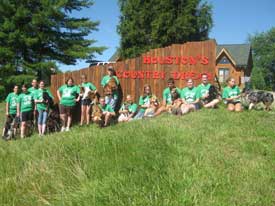
Twelve teenage girls, twelve dogs, four days and three nights. How does one manage that without yelling, nagging or feeling frustrated? Seven years ago, we started a 4-H dog camp along with another friend. Teenagers and their dogs come to camp and try a variety of activities: agility, obedience, tracking, nosework, flyball, and anything else we can imagine. Teaching the activities is the easy part, but how do you manage that many campers and dogs? TAGteach to the rescue!
The first few years of camp, we attempted to use TAGteach based on what we had been able to pick up on the internet and applying the principles of clicker training to people. It went... okay. There were parts that didn’t seem to work and we had a hard time implementing it. The campers still had a good time, but it simply didn’t work as smoothly as we wanted it to.
We Went to a TAGteach Seminar!
Until we went to a seminar. That’s when it all clicked for us. We came out of there simply bursting with ideas. It changed the way we taught, the way we managed campers, and most importantly, it changed the way we THOUGHT.
Yes, the tag points are important and the reinforcement schedules we have developed make a huge difference, but for us, the real value comes in how we think about our campers. We teach with positive reinforcement at camp. Period. It doesn’t matter if you are a dog, a camper, a counselor, or our nurse (though we do make a special exception for any stinging insects that enter our cabins!) we give you the privilege of learning in an environment free of intimidation, fear, yelling, or nagging. The shift into TAG thinking is what has allowed us to do exactly that.
An Amazing Shift in Mindset
For example:
We do all of our own cooking at camp and the campers use real plates, cups and silverware. This means that there are quite a few dirty dishes produced in one meal. One year, after spending too much time washing dishes, we had the brilliant idea to simply inform the campers that the tag point is: wash a dish. Each dish washed earns them a tag. Now, instead of having to nag them about washing dishes we simply say “tag point is wash dishes” and they get washed. We noticed an interesting phenomenon at camp that year. Campers were heard discussing who last washed dishes, but instead of it being in the vein of “I did it already someone ELSE has to do it this time” it was instead in the vein of “I have already had the dish washing opportunity for earning tags, who wants it now?” Which was an amazing shift in mindset for use to observe.
Creative Solutions
Also, as we have practiced TAG thinking, it has become more natural and creative and positive solutions to problems come easier to us. At camp this year, the campers were sent on the task of packing all of their stuff up right before the last camp activity. As soon as they were all done, we would be able to head up. The problem was, there was a lot of procrastination and it was impossible to tell if a camper was finished packing and just hanging about distracting the other campers or if she needed encouragement to get back on task.
The solution came to us in the when A then B tag point: When you are finished packing, the tag point is Popsicle. It worked brilliantly for several reasons. One, there was increased motivation for completing packing as the tag point was inherently reinforcing. Two, it was easy to see who was finished packing. And three, it is harder to be a distraction to other campers if you have a popsicle in your mouth!
By continually consciously practicing the art of TAG thinking, we have been able to make TAG a natural part of camp. Our campers have benefited significantly from our efforts, and your learners likely will tool!
Related Webinar
Click here for more information or to purchase the recorded webinar ($19.97)
Showing posts with label 4-H camp. Show all posts
Tuesday, July 9, 2013
Thursday, October 4, 2012
Tagging with Teens at 4H Camp
by Kristen VanNess
Reprinted with permission from the KPCT blog
I'm part of a group that runs a 4-H dog camp each summer called The Ohio 4-H Teen Dog Experience. A group of teens from all parts of Ohio spends several days with their dogs and new friends in an intense dog-training environment. Eleven 4-H'ers and their dogs attended the four-day camp in June, 2009.
Kids come from different areas of the state, and have varied experience levels coming into camp. Some campers are from 4-H clubs that do not even offer obedience or agility, and other campers compete extensively outside of 4-H. Most campers belong to clubs that do not use clicker training. However, all of the campers were enthusiastic about dogs, 4-H, and learning how to be a better dog trainer.
Reprinted with permission from the KPCT blog
I'm part of a group that runs a 4-H dog camp each summer called The Ohio 4-H Teen Dog Experience. A group of teens from all parts of Ohio spends several days with their dogs and new friends in an intense dog-training environment. Eleven 4-H'ers and their dogs attended the four-day camp in June, 2009.
Kids come from different areas of the state, and have varied experience levels coming into camp. Some campers are from 4-H clubs that do not even offer obedience or agility, and other campers compete extensively outside of 4-H. Most campers belong to clubs that do not use clicker training. However, all of the campers were enthusiastic about dogs, 4-H, and learning how to be a better dog trainer.
Tagging at camp
For several years, we have worked on ways to reinforce the teens attending the dog experience camp. After attending TAGteach seminars and working hard to strengthen our plans for camp learning, things went even better than we expected this summer.
In past years, raffle tickets were passed out for participation, helping others, and demonstrating good training skills. It was difficult to carry the tickets around, not to mention distributing them without interrupting a lesson. More than once, a piece of hotdog was offered to the kids and tickets were given to dogs! This year, every camper made a ten-bead Tagulator TM (an ingenious and very cool way to keep track of the many tags earned) to use throughout camp. Moving ten beads on the tagulator to the "I did it" end of the tool earned a camper a raffle ticket. The kids would probably have found tagging reinforcing enough without a raffle, but our end-of-camp raffle has become a tradition.
Throughout camp, clicks or a "thumbs up" were used to tag the kids. During lessons with dogs present, we were more likely to use a "thumbs up" or a verbal tag, but during our many non-dog activities, a tagger could be used. Kids were encouraged to tag each other, and often did.
We noticed that while kids sometimes forgot to bring a piece of equipment to lessons, they very rarely were without the tagulators!
Creative problem-solving
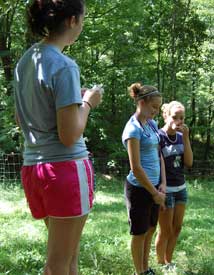
Early in camp, we did several sessions on creative problem-solving where the kids had to work together to solve tasks using a limited set of materials. We talked about how problem-solving could help with writing a training plan and solving training challenges. The lesson was not that the kids were able to accomplish the task at hand, but that they learned to brainstorm completely different solutions for any one challenge.
Throughout camp, we would TAG kids for use of creative problem-solving—resulting in more improvement than we anticipated. Some solutions they came up with were fabulous: move the target closer, walk the sequence without your dog, use our invisible dogs, tape the target to the floor. Of course, the kids moved on to brainstorming creative ways to get revenge on each other—and each other's cabins!
Vocabulary
One thing we made a point to TAG was the use of technical training vocabulary. Initially, we would TAG when any "training words" (timing, fluency, cue, front cross) were used. As camp went on, vocabulary tags were earned more for using training words in context. It was difficult to control my enthusiasm when the kids would offer suggestions:
"Maybe we should break it down."
"The latency is poor."
"The cues are similar—how does my dog tell them apart?"
"Let's use back-chaining!"
Place settings
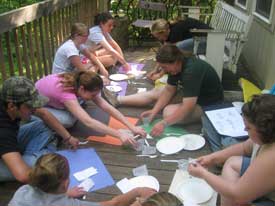
Cooking projects are a traditional part of 4-H. However, our campers come primarily from dog clubs and many have not experienced cooking-project judging and the associated lesson "learning how to do place settings." The place setting project is a great activity for teaching the campers about back-chaining, and is also an opportunity to learn a new skill.
Our brilliant Teen Counselors led the activity and directed the campers through the process of creating a place setting for a meal. The directions from the Teen Counselors specified the items to remove, the order in which to remove the items, and the requirements for different meals. Campers practiced setting and clearing the tables, placing cleared items in their laps to be ready for the next round. When cued to "return items," the campers would return the items in the correct order. A sample set of directions read as follows:
- Remove cup
- Remove plate (and above item)
- Remove fork (and above items)
- Remove spoon (and above items)
- Remove knife (and above items)
- Remove napkin (and above items)
- Remove place mat (and above items)
After ten minutes of training, the campers were able to set up three different place settings on different cues (breakfast, dinner, and dessert)—all with accuracy.
Throwing dumbbells
With a little rivalry between the two cabins of campers, there were many opportunities for competition. A dumbbell-throwing contest quickly found its way into our curriculum.
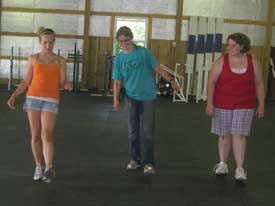
Both teams grabbed some dumbbells and spread out for fifteen minutes of strategy and practice. After a few throws, we noticed that one of our campers was very accurate. We watched him make several throws, and then created some TAG points based on his technique. With suggestions like "Let go at shoulder height" for when to release the dumbbell and "Straight arm when releasing," the group was throwing more consistently immediately. Performance did deteriorate under pressure; we'll add some activities next year to improve responses when stressed.
Teamwork
![]() |
| Photo courtesy of Megan Nelson |
Teenagers sometimes have the reputation of not being helpful. But, a few tags for various household tasks had the kids on top of everything. The doors stayed closed. The trash was emptied regularly. The kitchen area stayed clean. Buckle collars were on all dogs.
Soon the campers were going out of their way to assist each other with tasks. This might have been expected when the kids were comfortable with what they were doing, but it was completely unexpected with new tasks such as tracking. All eleven campers were learning tracking for the first time. After the first day, they would offer to help each other set tracks, which really surprised the instructor. The campers worked to get each other to participate in all activities, and continued to problem-solve on their own.
See you next year!
TAGteach and good lesson plans had a huge positive impact on camp this year, and on the progress each camper made within only a few days. The kids were happy to TAG each other and the instructors.
The focus moved quickly from what was going wrong to what went well. Campers weren't only thinking about reinforcing their peers, but also about reinforcing the instructors. I was very proud when I overheard several campers talking about telling one of the instructors that her dog had made huge improvements since the previous year.
Labels:
4-H camp,
peer tagging,
teens
Subscribe to:
Posts (Atom)