This blog is no longer being updated and we are in the process of updating all our articles and transferring them to a new improved blog.
Please visit our blog for the most up to date information on TAGteach
www.tagteachblog.com
Friday, October 21, 2016
Monday, November 17, 2014
TAGteach: Better than a Jedi Light Sabre!
This is an account by Seany Fdm Pogson, the father of a non-verbal child with severe developmental delay. Seany has been shaping new behaviors with his daughter, Tink, using TAGteach. Former efforts by therapists to teach Tink using hand-over-hand methods had not worked well and in fact Tink had rebelled against this touching by refusing to cooperate and regressing in some previously learned behaviors. Seany has had huge success with shaping many new behaviors and Tink is very tag savvy (and Seany is an excellent shaper!), so when Tink got sick and required oral antibiotics via syringe, Seany was able to avoid force and shape Tink to accept the syringe and happily take her medicine. Here is his account of this process:
Tink's not well and has an ear infection and the flu. Having an ear infection is also amplified by sensory processing problems, so making sure she has her medicine on time is important. Normally Tink's very good at taking her medicine but this morning not a chance. She pushed the syringe away. I tried once more this time Tink pushed the syringe away and avoided any further attempts by hugging her pillow in her play pen and biting it. This she will do when excited, stressed or if she just needs a hug and gets a hug from her pillow because sometimes she can't cope with the sensory of being hugged. So it was a no go, I couldn't even get anywhere near her mouth. Then I had a Jedi moment and a calm reassuring voice popped in my head like Ben Kenobi (Martha Gabler) "use the tag Seany". Straight away my own voice of determination popped in to my head and said "I can do this shit".
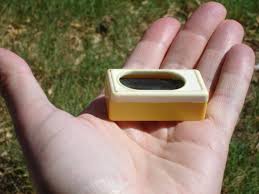
So I got the clicker from my pocket and sat near the playpen for a moment till Tink calmed down a bit from her rocking and biting on her pillow. Then I calmly reached over the to her with the syringe of medicine till I was about foot away from her face were she was burrowing it in the pillow whilst biting it. This was the first tag point and clicked and I paired it with praise "did it " (the clicker now has become a conditioned reinforcer). So I moved it forwards again a bit but waited till a brief pause in the biting as I moved the syringe closer and tagged again (clicked ) and verbal praise. This time as I tagged I noticed a brief sideways eye movement in my direction at the sound of the tag, so I seized the day and moved the syringe closer, tagged again and rewarded with "did it". Tink then moved her head up a bit sideways off the pillow, so again I moved the syringe closer about 2 inches from her mouth and tagged her. Then I moved the syringe to her lips were she grabbed it and put in her mouth and I was able to get over half in and tagged her and rewarded her with "did it yeyyyyyyyy ". At this point I was confident that she would do the same as the last time so I moved the syringe to her lips and she did exactly the same and she emptied the syringe so tagged and big "DID IT " and passed her drink to her.
This is how TAGteach and Applied Behaviour Analysis is teaching me to think. As I use it more, the more effective it and my thinking become. It's teaching me to think on my feet and apply it on my feet. This is far greater than any light sabre and more useful than any force. This is teaching me and my daughter at the same time.
TAGteach Jedi moments
So I got the clicker from my pocket and sat near the playpen for a moment till Tink calmed down a bit from her rocking and biting on her pillow. Then I calmly reached over the to her with the syringe of medicine till I was about foot away from her face were she was burrowing it in the pillow whilst biting it. This was the first tag point and clicked and I paired it with praise "did it " (the clicker now has become a conditioned reinforcer). So I moved it forwards again a bit but waited till a brief pause in the biting as I moved the syringe closer and tagged again (clicked ) and verbal praise. This time as I tagged I noticed a brief sideways eye movement in my direction at the sound of the tag, so I seized the day and moved the syringe closer, tagged again and rewarded with "did it". Tink then moved her head up a bit sideways off the pillow, so again I moved the syringe closer about 2 inches from her mouth and tagged her. Then I moved the syringe to her lips were she grabbed it and put in her mouth and I was able to get over half in and tagged her and rewarded her with "did it yeyyyyyyyy ". At this point I was confident that she would do the same as the last time so I moved the syringe to her lips and she did exactly the same and she emptied the syringe so tagged and big "DID IT " and passed her drink to her.
This is how TAGteach and Applied Behaviour Analysis is teaching me to think. As I use it more, the more effective it and my thinking become. It's teaching me to think on my feet and apply it on my feet. This is far greater than any light sabre and more useful than any force. This is teaching me and my daughter at the same time.
Read more about Tink:
TAGteach Tale: From Sensory Avoidance to Self-Feeding – Tink’s journey to successTAGteach Tale: Tink rocked her blood tests!
Find out more about teaching a special needs child with TAGteach:
Martha Gabler (autism mother) TAGteach blog - free tips and step-by-step descriptions
Free ebook by Martha Gabler: Behavior Basics - A Primer for Parents - ABA terminology explained in simple terms for parents
Friday, June 27, 2014
TAGteacher Tale: Success After a Seminar
One of the great things about a TAGteach seminar - attendees go straight home, put the techniques into practice and see success right away.
Below is an example of how fast you can implement TAGteach in your lessons.
From Dagmar, an attendee form a seminar in Switzerland:
Below is an example of how fast you can implement TAGteach in your lessons.
From Dagmar, an attendee form a seminar in Switzerland:
Dear Theresa:
This morning, I had great success using the things I learned at the TAGteach seminar in Sornetan.
It was the second lesson with the handler of two young dogs (16 and 18 weeks old). I knew her from a seminar I gave about calming stressed dogs.
We worked on a holding the leash in a manner that may help calm her dogs. Several behaviors including: taking hold of the leash, standing on one point, and relax as you hold the leash were put together and called "Standby". To simplify her focus, I attached a green piece of tape to her leash hand, and another piece of tape on her stomach. When she performed the "Standby" sequence, she just had to touch the two green pieces of tape together to have the perfect leash position.
The instructions were: "Standby" and The tag point was "green to green". First, I demonstrated and tagged myself, then I let the client tag me, and finally they tagged themselves.
First she felt a bit strange as she came from the hardcore dog training in German and Swiss dog places (Schutzdienst)...but then they realized how easily THEY learned the skills. I was so happy.
I repeated the mantra: “green to green” and as the students became more relaxed with their behavior, the dogs also began to settle.
Dear Theresa, dear Joey (Iverson), I thank you so much for opening up a world of giving training.I hope I will see again soon
Dagmar (the musician )www.hundelongierschule.ch
Upcoming TAGteach Seminars
Tuesday, June 10, 2014
TAGteach for Parents of Children Age 3-10
The TAGteach methodology has been used many
times with kids, (as you can see in this video), but this was the first time an
entire TAGteach Seminar was dedicated to parents and educators of children aged
3 to 10 years. The seminar was presented by TAGteach co-founder Theresa McKeon.
Theresa introduced us to TAGteach tools and the laws of behavior and how they
can be used to communicate with our children in a positive, caring, and
empathetic manner.
We were also able to discuss and watch
videos demonstrating how to change an emotion by changing physical behaviors as
seen in this video. Here the child’s
attitude towards swimming was changed by reinforcing the desired physical behavior.
Practical Applications
During the afternoon session we worked
together on three different projects to identify behaviors that can be
identified, highlighted, and reinforced in everyday situations.
EATING VEGETABLES: One group chose to use
successive approximations to introduce vegetables to their children. They could reinforce looking at vegetables,
then smelling, touching and finally taking small bites, observing the child's
body language to establish when they are ready for the next step. Theresa also
suggested that parents initially play tag game together “ignoring” the child.
The parents could start with the same approximations (looking, smelling,
touching, tasting) that are to be ultimately be performed by the child. In this way the child is gradually introduced
to the practice in a playful manner and with a low emotional impact.
RAISE YOUR HAND (Before speaking in the
classroom): In this scenario a single, specific behavior was requested by a
teacher. A focus funnel was used to provide context for the tag point.
The instructions are: Raise your hand before speaking
The tag point is: Raise your hand
Theresa suggested initially giving the
taggers to the students and having them ‘tag the teacher’ each time the teacher
performs the tag point, ‘Raise hand before speaking’. This process could help
the children participate in the learning process and pay more
attention to the teacher. The students could have tagulators hanging from their
desks and pull a bead each time the teacher raises her hand. After a few
repetitions, the teacher would collect the taggers and begin tagging the
student’s behavior of ‘Raise hand before speaking’. When all the beads have been
pulled, the students could choose a favorite activity as an added reinforcer.
HUDDLE ROUND: The purpose of this project
was to discover a positive way to gather children back together as quickly as
possible after being separated by activities within the classroom. The process
had to be compatible with a class of children ages 3 to 6 years.
The process started with the teacher taking
the hand of one child and proclaiming “Tag!” That child grabs another student’s
hand and calls “Tag!” and so on and so until everyone is holding hands in a
circle. They end with everyone raising their clasped hands in the air and
proclaiming “Tag!” In this way the children are part of the process of
gathering together physically and mentally with the benefit of having the children
part of the process.
A special thank you to all the participants
who have chosen to accept the challenge of finding new and positive ways to
interact with their children.
To Theresa McKeon who has accepted this new
challenge ... thank you is not enough!
P.S. Success!
Two days later I've got some news. One of
the teachers has already began to experiment the marker in her classroom and
one of the dads has already taught his son to tie his shoes!
Thursday, April 24, 2014
TAGteacher Tale: Helping Animal Shelter Volunteers Have a Great Experience
Volunteers are one of my favorite parts about
working for animal welfare non-profits. The community that is generated for a single mission can sometimes be
astounding. There are a variety of
reasons why people engage in volunteer activities. Some people volunteer to give back to their
community, others volunteer since they cannot have pets of their own and others
hope to develop friendships along the way. One common thread I see is people longing to learn new things and expand
themselves. So let’s give them what they
want! My philosophy is to empower
volunteers through education in order to develop a dedicated and helpful team
for the staff as well as the animals.
For the last 3 years, I directed the behavior
and training department at the East Bay SPCA in Oakland & Dublin, CA. During that time I developed nine volunteer
programs to help support our canine and feline populations. A few of these programs focused on canine and
feline enrichment, assisting dog training classes, canine jogging and exercise
as well as canine behavior modification.
Creating Educational Materials
In order to develop these programs I had to
create educational materials as well as hands on training curriculum. There were many skills the volunteers needed
to learn in order to safely interact with our animals. Some of these skills included what to do when
an animal mouths you, exiting and entering the kennel as well as offering an
animal space and time if they appear fearful. I have found that breaking things down into small steps for volunteers
can be most helpful when teaching a new skill. I used the principles of TAGteach in order to help each learner absorb
the information and develop the necessary handling skills.
Developing Your Own Trainings
In my upcoming webinar, I will discuss handling
skills all volunteers should know when working with animals. I will also showcase videos demonstrating
volunteers learning these and other skills.
Since every shelter is different, it is important for you to take the
knowledge you learn from this webinar and be able to apply it to your facility. Therefore, I will discuss how to develop
TAGteach trainings for your own volunteers so you can all reap the benefits of
this way of teaching.
Webinar!
Click here for more information or to register.
BONUSES!
In celebration of its International Dog Bite Prevention Challenge, non-profit Doggone Safe will donate a Shelter Family Safety Kit in a random draw to one attendee at the end of this webinar. This kit contains materials to help educate the families that visit the shelter about how to treat pets with respect, read dog body language and prevent dog bites. The retail value of this kit is over $300 and it contains:
1 Be a Tree Teacher Kit (contains 15 large heavy weight dog body language posters and more)
50 Coloring Books
20 Story Books
2 Posters
500 stickers
Anyone with a shipping address in the US or Canada who registers for the webinar will be eligible for the draw. So even if you can't attend, register anyway! You will automatically receive the recording when it is available.
To find out more about the contents of the Shelter Family Safety Kit, visit the Doggone Safe store.
BONUS#2! When you register for this webinar you will receive a discount code for 25% off our recorded webinar: TAG! Not Just Another Game at Camp. If your shelter runs summer camps for kids, this webinar will give you lots of great ideas for fostering cooperation and fun for your campers
BONUS #3! When you register for this webinar you will receive a discount code for 25% off our recorded webinar: Leave it! Impulse Control for the Teacher with TAGteach cofounder Theresa McKeon, since this is a great complement to this webinar for training shelter volunteers.
Thursday, April 17, 2014
TAGteacher Tale: Junior Scholars Love TAGteach
By Sarah Cook
After many happy years as a teacher at A Dancer’s Dream, I recently branched out into the world of public education,
accepting a position as a full time dance teacher in a charter School network
in Boston, MA. For those unfamiliar with A Dancer’s Dream, it is a wonderful
studio where every teacher is TAGteach certified and the children are very tag
savvy. This particular charter school network is a high performing K-8 charter
school with 3 campuses. The schools are academically rigorous, have a very
strict behavior policy, and are huge on positive reinforcement and behavior
narration. They also have every student
take dance. The dance classes are large, with 27-32 students per class. Needless to say, I have my hands full.
After a year and a half of struggling with
huge classes, no mirrors, and less than perfect dance ‘studio’ conditions, I
asked my principal if I could start using TAGteach. She said yes and I breathed
a huge sigh of relief. I could finally introduce TAGteach and the audible
marker to all my classes. Below are a
few highlights from our first week using TAGteach.
Sixth grade: We are well into our tap unit. With 27 kids
in class, it’s challenging to see and correct the mistakes of every child. How do you solve problems like too many kids,
not enough time? With TAGteach, of course! After watching the entire class
attempt flaps (a tap skill) and making a mental note of the most common errors,
I chose one student to start the process.
I explained what a tag meant and how it helps your body and brain
learn. In less than two minutes and with
only two tag points, his flaps were fixed. Not only did it fix his flaps, but
everyone in the class vastly improved after watching the TAGteach session. They
were thrilled and just a little amazed. I was just reminded of the
effectiveness of TAGteach
.
First grade: There are 32 children in this class
(THIRTY-TWO CHILDREN!!) In an effort to streamline my classes, I decided to
start using TAGteach to work on class management first. As the class began, I
kept an eye out for the first scholar who quietly sat down in crisscross.
Without saying a word, I tagged him and voila!
The room went from chaos to silence in 3 tags. It was so easy, They
figured out right away that if they didn't get a tag, they could look at a
friend who did get tagged and fix their behavior to match. My entire class was
silent, ready to go without redirection from me and in less than a minute. One
scholar told me “I like the tagger because when you tag one person, we all know
what to do without you talking and wasting our learning time”. Right on, kid - me too.
I am so excited to have brought this tool
to my school. We accomplish more in less time, our practice is more deliberate,
and everyone is happier. I know it makes helps me stay calm and focused.
Now, someone remind me why I hadn't done
this before…? Stayed tuned for more Adventures of Tagging in the classroom!
Tuesday, March 18, 2014
Using a Verbal Marker to Signal Success for Your Learner
By Joan Orr MScLet me just apologize right up front for the title of this article. I am not in fact going to explain how to use a verbal marker, or to expound on the benefits of verbal markers. In fact the opposite is quite true, if disappointing to some.
I am not a fan of the verbal marker (that is using a word such as "yes" or "good" to mark a correct response). The more experience I get with TAGteach and clicker training, the more firmly I believe that the verbal marker is inferior to the tag sound (click) in teaching new skills. We have used taggers (clickers) with everyone from tiny tot ballerinas to business professionals to fishermen with lots of muscles and tattoos who work in the Bering Sea (see previous blog posts for the tale of the fishermen). We have used taggers with elite athletes, kids with autism, kids with Down syndrome, business professionals, prison inmates and medical students to list a few examples. Using the tagger absolutely works and it works with every population of learner that we have encountered.
Why Did She Get a Better "Good" Than Me?
We at one point back in the time before we had as much experience as we have now had suggested to people that they might use the word “good” or another verbal marker to signal success to the learner. In practice this has turned out not to work well. The verbal marker becomes very repetitive and annoying very quickly. It seems condescending in a way to say “good, good, good” over and over especially to another adult. It is also very difficult to keep the tone of the “good” the same each time. People tend to want to convey additional information with the verbal marker. They tend to vary the tone and give a more expressive “good” if there is a particularly good effort. It is hard to avoid the big excited “YES” when they finally get it, or the desultory "yes" when you're tired, hungry and have a headache.
A teacher may inadvertently vary the tone of the "good" for different learners, and trust me - they notice! The learner wonders why they didn’t get the big “good!!” the next time or why another person got a bigger “good” than they did. Learners no matter how young can tell the difference between genuine praise and a rote "good job".
The verbal marker inevitably mixes praise with information. This defeats the purpose of using a marker. The marker must be the same every time and must convey only one piece of information “you got it right”. There are no degrees of “rightness”. It is either tag or no tag (click or no click). This allows the learner to focus only the task at hand, the tag point, and not to have to process verbal information at the same time.
Praise is Great, but Not as a Precise Marker of Behavior
I am not saying that praise is bad, or that there is no place for it. What I am saying is that words cannot be used as markers as effectively as a neutral sound because words inevitably convey more than just the critical information (yes! you got it). The way to use praise effectively is in concert with the marker. Tag without talking and at the end of the tag session, give the verbal praise. For example, the learner might get 10 tags and then you end the session and say “You’re doing really well” or “you are hitting your tag point much better than yesterday” or “Fantastic!!!”
Our classic Highjump Video demonstrates this nicely. There is no talking other than to give the tag point, no feedback other than the tag and then the verbal, heartfelt praise at the end.
We have been trying to work out in our own minds the problem with the verbal marker and over time we have come to the conclusion that is the mixture of praise with information that is at the heart of the problem. Separate praise from information and you will get better results and more satisfied learners.
But I Just Can't Use a Sound Marker
There may be times where it is not appropriate or not possible to use a sound marker. You may have used the tagger for an intense teaching session and your learners are starting to fade. Not to worry! You can still use the principles of TAGteach in all your teaching. While you will not get the incredible power of TAGteach without using a tagger, you will still benefit from using the TAGteach principles. We call this Naked TAGteach (TAGteach without the tagger) and we have a webinar that explains this in detail. Click here for more information or to purchase.
More About Verbal Markers and Why the "Tag/Click" Sound Works so Well
Read an article by Karen Pryor: Bingo! You Win!
Watch a video clip from Karen Pryor on the neurobiology of TAGteach and why the tag sound works so well:
Related Resources
Wednesday, February 26, 2014
TAGteacher Tale: A Winning Approach to Transforming Your Instructor
"I
explained a few of the tools to my coach Grant Grinnell (USPTA) and he was
willing to give it a shot. After just a few tries, he was totally sold on the
value of TAGteach and the powerful learning it facilitates. He commented that
there was more improved play in my game within a single lesson. He also
noticed that although it was easier to get information to me with the marker,
it also required a different focus. In a group lesson he is usually trying to
take in what each of the players is doing. To tag me for the skill, he
had to momentarily keep his focus on just me or he would miss the marker
timing. Both of us had complete focus and that brought about immediate
improvement."
It seems Joey’s coach is as excited about
TAGteach as she is:
“I love
everything about what you've taught me. I love the tag, I love the
positive reinforcement. I love no negative connotation. I love the focus of
what I need to do and I love the focus of what students can do if they are
tagging somebody else. I love everything about it, it's fantastic and I plan on
using extensively in my teaching in the future.”
The word is spreading fast. After watching
a TAGteach session between Grant and Joey, another coach, Chad Smith USPTA
wanted in. It wasn’t long until he found exactly why TAGteach worked for
him.
“TAGteach worked for me because I could
mark the exact point I need my students to feel in my lessons. My students
quickly associated the tag with what I was trying to get them to understand in
their technique. It made my instructions that much more effective.”
Thank-you Joey for spreading the word
effectively and kudos to Grant and Chad for being coaches that are open to new
concepts that improve learning for their students!
USPTA Tennis Coach Grant Grinnell Talks About TAGteach
DOUBLE BONUS! Register for the Sport Coaches webinar recording and you will get a 50% off pass for your coach or instructor.
Monday, February 24, 2014
Upcoming TAGteach Events - Learn to Be a More Effective Teacher, Instructor, Coach or Parent
TAGteach Primary Certification and Training Seminar
Date: Apr 5-6, 2014
Location: Seattle WA
Get more info and register
TAGteach Webinar: Fluency - Who Needs It?
Date: Apr 10, 2014TAGteach Webinar: How to Use TAGteach to Teach Handling Skills to Animal Shelter Staff and Volunteers
With Luca Canever
Get more info and register
Date: May 6, 2014
With Marissa Marino
Get more info and register
TAGteach Webinar: A Winning Approach to Transforming Your Instructor
Date: May 20, 2014
With Joey Iversen
Get more info and register
Seminaro TAGteach
Date: May 17-18, 2014
Location: Arezzo, Italia
Informazioni e Iscrizioni
En kväll om TAGteach med Eva Bertilsson
Date: May 22, 2014
Location: Halland, Sweden
mer information
TAGtots! for Parents and Teachers of Young Children
Seminario TAGteach per Genitori ed Educatori
Date: May 24, 2014
Location: Verona, Italia
Get more info and register/ Informazioni e Iscrizioni
TAGteach Advanced Workshop and Level 1 Certification
Date: May 29-30, 2014
Location: Birmingham UK
Get more info and register
TAGteach Primary Certification and Training Seminar
Date: Jun 6-7, 2014
Location: Sornetan, Switzerland
Get more info and register
TAGteach Advanced Workshop and Level 1 Certification
Date: Jun 8-9, 2014TAGteach Primary Certification and Training Seminar
Location: Sornetan, Switzerland
Get more info and register
Date: Jun 21-22, 2014
Location: Valencia, Spain
Get more info and register
TAGteach Primary Certification and Training Seminar
Date: Jul 16-17, 2014
Location: Adelaide, Australia
Get more info and register
TAGteach Primary Certification and Training Seminar
Date: Jul 19-20, 2014
Location: Brisbane Australia
Get more info and register
TAGteach Advanced Workshop and Level 1 Certification
Date: Jul 22-23, 2014
Location: Brisbane Australia
Get more info and register
TAGteach Primary Certification and Training Seminar
Date: Jul 26-27, 2014
Location: Hamilton, New Zealand
Get more info and register
Thursday, February 20, 2014
Everybody Needs Fluency!
By Luca Canever
How many times, during our lives, have we been told to "Pay attention"? At school, driving our cars, playing sports, at work, at home or crossing the streets. The world is constantly demanding our attention. The problem is that we shouldn't pay attention… At all!
D. Eagleman, in his book "Incognito, The Secret Lives of the Brain", wrote:
“When athletes make mistakes, coaches typically yell: 'Think out there!' The irony is that a professional athlete's goal is NOT to think. The goal is to invest thousands of hours of practice so that in the heat of the battle the right maneuvers will come automatically, with no interference from consciousness. The skills need to be pushed down into the players' circuitry. When athletes ‘get into the zone’, their well-trained unconscious machinery runs the show, rapidly and efficiently. Imagine a basketball player standing at the free throw line. The crowd yells and stomps to distract him. If he's running on conscious machinery, he's certain to miss. Only by relying on the overtrained, robotic machinery can he hope to drain the ball through the basket".In my webinar "How the Brain Learns" I discussed some of the mechanisms used by the brain to learn. In this next webinar we will explore how the brain uses the learned information to attain that which should be the goal of every learning experience: Fluency. As Eagleman writes fluency allows us to perform difficult tasks even in noisy and distractive environments. We don't have to think about our behaviors. We, simply perform them. We don't think which muscles and joints we use when we walk. Try this experiment: stand up and take few steps forward, naming - or paying attention - to each single movement. Your performance will be poor and extremely slow. We don't pay attention, but we can walk to the kitchen efficiently to have a glass of water.
Fluency allows us to pay attention only to the new things: potential new threats or new reinforcers. All the rest runs smoothly, controlled by many other brain circuitries whose workings are largely unknown (do you have to think to breathe?).
How do we become fluent? The answer is rather simple: we need to practice. The more we practice the more we become fluent. But, practice is not just the repetition of an action. Deliberated Practice (as Dr. K. Anders Ericsson named it) is purposeful, with clear goals, and precise settings. It requires a great amount of self-sacrifice and great self-control to engage in this kind of practice. But, if you want to play with the Seattle Seahawks this is the only way. Obviously genes matter and if you're tall you will have more chance of playing for the Lakers. But, as we'll see genes aren't enough by themselves. You have to master the component skills of your discipline, put them together in complex behaviors and merge the behavior in stunning performances. AND, above all you have to find the practice reinforcing to keep going.
TAGteach is the perfect methodology to give us the reinforcing practice we deserve to explore our talents, and during the webinar we'll see how TAGteach methodology fits well in the theoretical scaffold scientists are discovering. We'll visit also some Renaissance painter's shops. Leonardo needed fluency to paint his Mona Lisa.
Click here to register for Luca's upcoming webinar: Fluency - Who Needs It? (Apr 10, 2014 3-4 PM EDT)
Register for the Fluency Webinar and you will get a 25% discount coupon for the recorded webinar: How the Brain Learns (not applicable on top of the member discount)

Wednesday, February 19, 2014
TAGteacher Spotlight - Marissa Martino
For the past 7 years, Marissa Martino has been working with dogs and their human companions in a variety of settings. She started her career working for the Humane Society of Boulder Valley in Boulder, CO. There she implemented a Behavior Modification Program for shelter dogs with various special needs: such as fear, separation anxiety, resource guarding and dog-dog aggression. After two years in Colorado, she moved to San Francisco to expand her horizons. There she started her position at the East Bay SPCA as the Director of behavior and training. During this time, she attended a Clicker Expo in California. There she attended a TAGteach seminar taught by Theresa McKeon.
After listening to Theresa and observing a TAGteach demo, Marissa was hooked! She loved how the emphasis of the seminar was on the human learner instead of the dog. As a dog trainer it is very important that we know how to train dogs; however, training the owner is even more important! The owner is the one living with the dog and following through with the training plan. If he/she does not fully understand the concepts and how to implement them, the dog’s behavior may not change or may even get worse. This is both detrimental to the trainer as well as the relationship between the owner and the dog.
During her time at the East Bay SPCA, Marissa has developed nine volunteer programs where volunteers have hands on experience with dogs and cats of the shelter. The main purpose of these programs is to enrich and enhance the lives of all involved, the dogs and cats as well as the volunteers. Marissa’s main priorities were to articulate how to safely handle shelter animals and empower the volunteers to make smart decisions during their shifts. She decided what hands on skills they needed to know and used the TAGteach principles to educate the volunteers. The feedback she received from the volunteers was astounding. They were able to remember the skills they had learned during their shifts since their education experience was simple, easy and fun! Marissa not only uses TAGteach in her curriculum designs but also in her everyday life and with her loved ones. She believes in its powerful messaging of identifying what you want people and animals to do, reinforcing this behavior and ultimately empowering the learner!
Join us for a webinar presented by Marissa on the topic of Teaching Handling Skills to Animal Shelter Volunteers on Tues May 6, 2014 at 11 AM EDT
Price:
$19.97
$9.97 for TAGteach Members
Price:
$19.97
$9.97 for TAGteach Members
Tuesday, February 4, 2014
TAGteach and Autism: The Time Has Come!

By Martha Gabler MA
The purpose of this article is to introduce you to a new type of support for children with autism: the acoustical support. Most people are familiar with adaptive equipment for children with physical disabilities such as wheel chairs, braces, and work platforms. In the autism community, most people are familiar with visual supports: picture systems, schedules, token boards, and so forth. These visual supports play a crucial role in educating children with autism and have proven to be extremely useful in both home and school settings.
Introducing the acoustical support
The child starts to pay attention
As a parent, when I started using a neutral sound (a “tag” or click) to indicate to my son which behaviors of his would earn treats, he started doing more of those behaviors. My son was loud, chaotic and wild in the early years. He had self-stimulatory and aggressive behaviors. With my conditioned reinforcer (sometimes referred to as an “event marker” or a “tag”), I was able to tag my child every time he did something good. “Good” things were behaviors like Quiet Mouth, Both Feet On The Floor, Hands Still, or Eye Contact. The procedure is: Observe child, press clicker (tag) when child performs the desired behavior, then reinforce child (give a treat or token).
Tantrum busting
My son became more skilled and happier the more I tagged

Clear, precise information for the child with no emotional or sensory burden
The time has come for TAGteach for autism
About Martha
Martha Gabler is the mother of a non-verbal teenager with severe autism. She holds a Bachelor's degree from Vassar College and a Master's degree from the George Washington University Martha lives in Silver Spring, Maryland with her husband and two sons. Her older son is at university pursuing a degree in mathematics. Martha runs a tutoring company called Kids' Learning Workshop LLC, and is the author of the book entitled Chaos to Calm: Discovering Solutions to the Everyday Problems of Living with Autism. Martha writes articles to help other autism parents solve or prevent behavior problems at her blog: www.AutismChaosToCalm.com. Martha loves to hear from readers and to answer questions at her Facebook page.
Labels:
autism
Tuesday, January 28, 2014
TAGteacher Spotlight - Luca Canever
![]() |
| Luca (on right) with fellow TAGteachers Eva and Emelie |
“Working with animals through positive reinforcement is an experience that enriches you. Bring this same experience on the relationship with people is something that changes your life! The first time I read about TAGteach I immediately said "I MUST do this!" And it's true: my life and myself changed. TAGteach has increased my awareness of what the other people are doing and why they’re doing it (and I can guarantee you. if you have a four years old boy this a really helpful skill). I became a "TAGthinker". Constantly I strip down things happening around me and reassemble them in tag points. The challenge now is to be able to introduce the TAGteach here in Italy. In this my thanks go to TAGteach International for their help and support and to Theresa McKeon who last year agreed to held a Primary workshop here in Verona, and this year she took on the challenge of co-present with Laura Monaco Torelli and myself the Dynamic Duo Seminar. My goal with this seminar is to share the deep similarities that exist between education and training humans and animals. When we all will know that there’s a new, caring methodology –that works-, to deal both with people and animal I think the world will be a better place to be in”.
Luca has used TAGteach with volleyball and basketball teams, with his clients and with his son. He also learned medieval swordplay with his nephew using TAGteach methodology.
Luca is a Level 3 TAGteacher and offers TAGteach Workshops and Certification Seminars in Europe in both English and Italian. Visit http://www.tagteachitalia.com/ for more from Luca.
TAGteach and Neuroscience - How the Brain Learns
Luca is a scientist with an interest in the neurobiology of TAGteach and how learning works in the brain. One of the amazing thing about TAGteach is the speed at which it works. Sometimes it seems almost magical! Turns out that the reason for this is because TAGteach is perfectly suited for optimal learning, because of the way the brain learns and retains information. Luca explained this in a fascinating webinar. Click here for more info or to register for the recording.Tuesday, December 17, 2013
TAGteacher Tale: I Cried Like a Baby for an Hour
By Kelly Drifmeyer
My name is Kelly Drifmeyer, I’m a classical musician on the Horn (French Horn), and a college professor at the Crane School of Music, SUNY-Potsdam. I’ve also trained and enjoyed the company of golden retrievers for 24 years.
I first woke up to the idea that I could learn and teach in a different way about 23 years ago. My early learning experiences as a hornist were with artist-musicians I think of as “old school” teachers. They learned how to teach from their teachers, and they from theirs, back to the European masters of the instrument back to who-knows-when. What they all had in common was a thick language of instruction on “how” to do things, and a negative and often punitive style of correction when you didn’t do those things right. There was one right way – their way – and to not follow instructions to the letter, or not provide the ideal result, was an invitation to a browbeating, embarrassment, or demeaning and sometimes harsh verbal correction. “You’ll never be successful sounding like that…that’s not good enough…you better find a different career,” these were all commonplace comments in both my own experience and the experiences of my fellow students. None of us liked it, but it became a badge of honor to survive lessons under those conditions and not break down.
When I started my own music teaching, it was about the time I also began formal dog training. In the early ‘90’s in my area this consisted of the “jerk and release” methods of instruction and correction. You said “good girl” in an anemic sort of way if they did it right, and yanked them around on the end of a leash when they didn’t. My first, sensitive golden began to avoid me on training nights, and at home she would startle and cower at the slightest raising of my voice – whether it was meant for her or not. We stopped training, how could I keep abusing my sweet girl like that? I finally went hunting at the bookstore for something different (this was pre-Google!) and stumbled upon “Don’t Shoot the Dog!” by Karen Pryor. I read it, and re-read it, and felt immediately guilty for being so stupid when there was such an obvious alternative. A “clicker” wasn’t easy to come by, but I found one eventually and off we went into dog training happiness.
It was quite a while later when I connected the dots to myself, and to my horn students. My early training (and being a perfectionist) had left me with a pile of mental self-abuse chatter that turned “on” every time I picked up the horn. I couldn’t practice, rehearse, or perform without a stream of negative thoughts flowing through my head. I almost quit the profession twice. I struggled with auditions, the one and only way to get a job in the performance field. I played beautifully at times, and had meltdowns at others. Nothing was ever “good enough”, so the angry commentary never stopped. Worst of all, I saw the same attitudes and negativity in my own students.
Tagteach isn’t where I started, but it is where I ended up. I tried the Artist’s Way, the Inner Game books, Peak Performance ideas, even “positive speaking” models, nothing solved the problem completely - until I picked up my dog clicker and used it on myself. I gave myself one task, used positive-only feedback, and ignored the bad stuff because it didn’t matter. The first time I tried it, I cried like a baby for an hour. And then went back and did it again.
I used this method for several years on my students and on myself before I discovered TAGteach in 2010. Another revelation – I wasn’t secretly doing something bad by using my dog training skills on my students, other people were doing it too! I read every inch of the website, watched every video I could find, took the online class and wanted more. In Spring 2011 I went to my first workshop with Theresa McKeon and it was amazing! I didn’t have the easiest time there – I had been using a self-taught method with a more relaxed structure, and I struggled with the new format and new terminology. But with practice has come an understanding of how the language of TAGteach helps me define my own thoughts, and helps my students with their own frame of reference.
I now use tagging regularly for specific tasks with all of my students. They universally respond in a very positive way, and many of them will ask for a tagging session when they find they’re struggling with a particular activity. I don’t use it every lesson, or for everything, but its an invaluable tool when working on high stress or high frustration problems. I find it to be especially effective when working on more physical issues. Musicians frequently work with muscles on a micro level – tiny, flexible motions of tiny, fragile muscle groups. Stress and tension can ruin the ability to use these muscles correctly, and I’ve found tagging lowers frustration, which lowers tension, which creates a calmer, more relaxed learner. And like magic, the relaxed learner is a successful doer.
The “magic” of TAGteach was brought home to me just a few weeks ago. I have a new student, “Amy”, who is bright, hard working and dedicated. She is also a mental and physical mess – tight, twisted posture, loads of tension, and a low threshold for frustration. She gets upset at the smallest things, and I sometimes walk on eggshells trying to get her to correct a problem without having a full-on meltdown. I’ll be honest – Amy was not my favorite student. I was irritated by her touchiness, and I’d lost patience with her meekness and sensitivity. It was no surprise that in a recent lesson, I found myself correcting, and correcting again a singular problem she could not seem to manage. I was getting frustrated, my voice was getting louder - when I noticed her hunching lower and lower in her chair, getting smaller and tighter at every attempt. Just like my sweet, sensitive golden almost 20 years ago.
Stop, I said to both of us. I took a deep breath and picked up my tagger. “This is a tagger. When you hear this sound - *click* - you’ll know you’ve done it right. If you don’t hear the sound, just try it again, no problem.” That’s all I told her the first time out. I took her through a focus funnel – explained what we were doing, then defined a single task, then gave her a single tag point – and off we went. And I felt stupid all over again for not having done it weeks earlier – she was finding success within ten minutes. And more importantly, she was then able to successfully integrate the new skill into a larger, more complex format. She also remembered, and repeated, the newly won skill for me the next week, and the next.
What’s most interesting to me about this story? I like Amy more now than I used to. We’ve found a way to communicate that takes some of the friction out of our relationship. She learns more confidently, and I’m also more relaxed, knowing I can say what I need to without hurting her.
TAGteach is an elegant, simple, precise language I use to interact with myself and with others. It’s a gateway to learning and teaching that bypasses the traditional use of negative feedback that so often produces frustration, stress, anger, and resentment. The teaching of musicians is shrouded in those traditions passed on through generations. That seems great to me in “what” we learn, but “how” we learn it needs some help. TAGteach resolves so many of the barriers to effective learning and retention, I’m spending a semester on sabbatical in 2014 to improve my own understanding of TAGteach and show others in my field how useful it can be.
Kelly Drifmeyer
Associate Professor of Horn
The Crane School of Music SUNY-Potsdam
Potsdam, NY 13676
drifmekb@potsdam.edu
Wednesday, December 4, 2013
TAGteacher Tale: A Winning Approach to Transforming Your Instructor
"I
explained a few of the tools to my coach Grant Grinnell (USPTA) and he was
willing to give it a shot. After just a few tries, he was totally sold on the
value of TAGteach and the powerful learning it facilitates. He commented that
there was more improved play in my game within a single lesson. He also
noticed that although it was easier to get information to me with the marker,
it also required a different focus. In a group lesson he is usually trying to
take in what each of the players is doing. To tag me for the skill, he
had to momentarily keep his focus on just me or he would miss the marker
timing. Both of us had complete focus and that brought about immediate
improvement."
It seems Joey’s coach is as excited about
TAGteach as she is:
“I love
everything about what you've taught me. I love the tag, I love the
positive reinforcement. I love no negative connotation. I love the focus of
what I need to do and I love the focus of what students can do if they are
tagging somebody else. I love everything about it, it's fantastic and I plan on
using extensively in my teaching in the future.”
The word is spreading fast. After watching
a TAGteach session between Grant and Joey, another coach, Chad Smith USPTA
wanted in. It wasn’t long until he found exactly why TAGteach worked for
him.
“TAGteach worked for me because I could
mark the exact point I need my students to feel in my lessons. My students
quickly associated the tag with what I was trying to get them to understand in
their technique. It made my instructions that much more effective.”
Thank-you Joey for spreading the word
effectively and kudos to Grant and Chad for being coaches that are open to new
concepts that improve learning for their students!
USPTA Tennis Coach Grant Grinnell Talks About TAGteach
DOUBLE BONUS! Register for the Sport Coaches webinar recording and you will get a free pass for your coach or instructor.
Saturday, November 30, 2013
What Do a Sea Hare and Stephen Hawking Have in Common?
We are often asked why it is that TAGteach works so well and so fast, sometimes yielding behavior change or learning that seems magical. There is no magic involved, except that which goes on in our brains. Level 3 TAGteacher Luca Canever presented a fascinating webinar about how the brain learns and why TAGteach works so well.
By Luca Canever
I am pleased to have this chance to share my passion about the brain and how it learns, with my fellow TAGteachers. Here is a brief outline of the topics I will cover in my webinar:
The TAGteach mantra "talk less, teach more", seems counter-intuitive, but there is sound science behind this. In this part I want to discuss how working memory works in the brain. The role of this specific memory is to catch things from environment to ensure our survival. We can think of the working memory like a window from which our consciousness looks at the world. Also the working memory creates the memories for the long term memory. If we overload the working memory with too nmuch information it won't be able to pass on the memories, and the learning will stop. Too much information it's not good for the learning. TAGteach, indeed is.
Earth had 3 billion years of bacteria, before life discovered associative learning. Life had blossomed about 540 million years ago when the first multicellular organisms discovered associative learning. If you know (and you can remember) where you can find food, mating opportunities and where your predator is waiting for you, your survival chances will increase. Organisms have learned by association for millions of years, so the argument that TAGteachers sometimes hear from parents: "Don't treat my daughter like a dog!" makes no sense. From the lowly sea hare to the brilliant Steven Hawking, we all learn in the same way. What is different is the complexity in the brain. But I'll give references to recent findings that indicate our (human) brains are not brand new. On the contrary they use pieces and parts that already exist and adapt them to our new requirements.

In his book "Thinking fast and slow", Daniel Kahneman says that each of us has his/her own, clear idea of what a car is. But if you ask two people to draw a car what you get is two different things. At the same time we can understand each other because we "share" the idea of "car" or "table". We can develop a common language because my representations in my brain are similar to yours. The memories in the brain are not "single-folder" kind. Memories are maps in the brain with different pattern for everyone. TAGteach helps because with the WOOF rules creates a crystal clear tag point that is clearly understood by both teacher and learner.
Click here for more information or to register for the webinar recording

By Luca Canever
I am pleased to have this chance to share my passion about the brain and how it learns, with my fellow TAGteachers. Here is a brief outline of the topics I will cover in my webinar:
Working Memory and Cognitive Load
Associative Learning: What a Sea Hare and Stephen Hawking Have in Common
Earth had 3 billion years of bacteria, before life discovered associative learning. Life had blossomed about 540 million years ago when the first multicellular organisms discovered associative learning. If you know (and you can remember) where you can find food, mating opportunities and where your predator is waiting for you, your survival chances will increase. Organisms have learned by association for millions of years, so the argument that TAGteachers sometimes hear from parents: "Don't treat my daughter like a dog!" makes no sense. From the lowly sea hare to the brilliant Steven Hawking, we all learn in the same way. What is different is the complexity in the brain. But I'll give references to recent findings that indicate our (human) brains are not brand new. On the contrary they use pieces and parts that already exist and adapt them to our new requirements.
Maps in the Brain - Why My Car is not Like Yours
Click here for more information or to register for the webinar recording

Subscribe to:
Posts (Atom)